How We Hire at NeoRecruit: What Using Our Own Platform Has Taught Us
We use NeoRecruit to run our own hiring. Here is what the real data from our own mandates has taught us about candidate behaviour, CV reliability, and what AI interviews actually reveal.
There is an obvious credibility test for any hiring platform: does the team that built it actually use it to hire?
We do. NeoRecruit runs its own hiring mandates through the platform, using the same adaptive AI interviews, CV screening, NeoEye fraud detection, and shortlist preparation that our clients use. We do not have a separate internal process. We eat our own cooking.
What we have learned from doing this has been, in several cases, genuinely surprising. Not all of it is flattering to the assumptions we started with. Some of it has changed how we think about what hiring actually measures.
This article shares the real numbers from our own mandates, what they mean, and what we think they imply for any hiring team evaluating AI interviews.
The Completion Rate Numbers
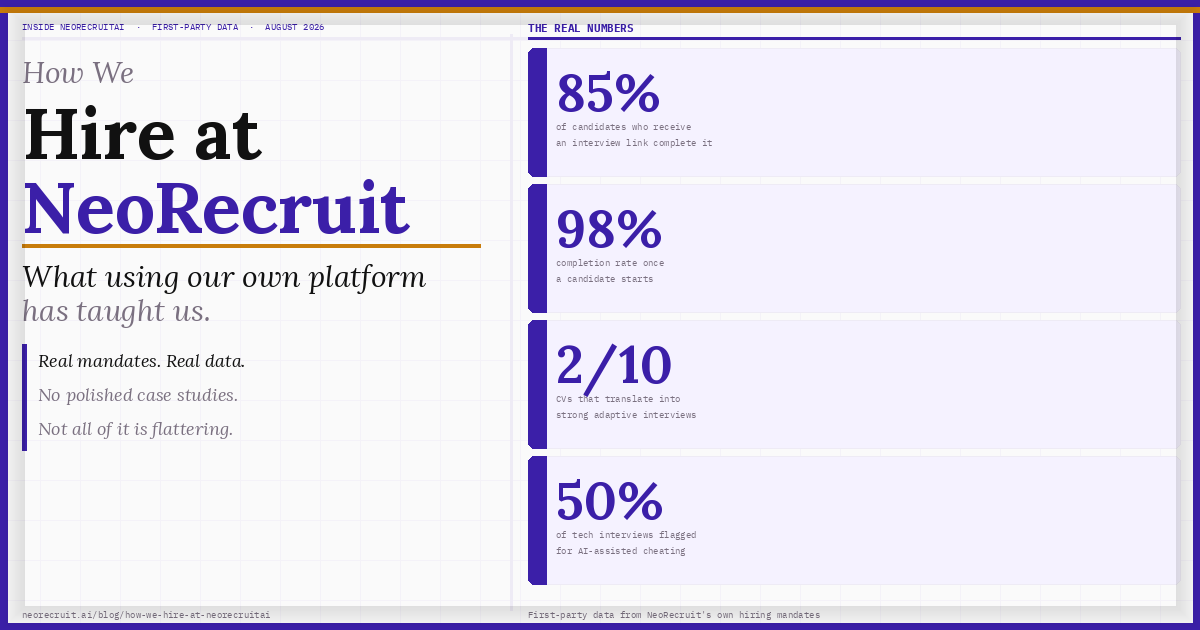
Once a candidate receives an interview link from NeoRecruit, 85% complete the interview. That figure surprised us initially, because the conventional wisdom in HR technology is that async and AI-led formats face significant candidate drop-off, particularly among senior candidates who are not actively desperate to move and can afford to be selective about which processes they engage with.
Of those who start the interview, 98% finish it.
The 15% who do not complete after receiving the link are almost entirely candidates who received the link but never opened it, not candidates who started and abandoned midway. Once a candidate engages with the adaptive interview format, they almost always see it through.
We think this reflects something about the format itself. A one-way video interview where a candidate records themselves answering fixed questions into a camera has a well-documented dropout problem because the experience is uncomfortable and feels performative. An adaptive conversation, where the AI avatar asks follow-up questions based on what you actually said, feels more like a real interview. Candidates do not feel like they are auditioning for a recording. They feel like they are being listened to.
The 98% completion rate is the most practically useful number in this article for hiring teams thinking about candidate experience. The format that produces the best assessment signal also produces the best completion rate. Those two things are usually in tension in hiring design. Here they are not.
The CV Reliability Problem
This is the finding we talk about most internally, and the one that has the most significant implications for any hiring team that still treats the CV shortlist as a reliable starting point.
Across our mandates, approximately 2 in 10 candidates who performed well enough on paper to be invited to an AI interview also performed well in the actual adaptive interview. That number rises to around 4 in 10 for roles requiring eight or more years of experience.
Read that carefully. The majority of candidates who looked good on paper did not demonstrate genuine capability when asked to reason through specific situations in real time. For junior to mid-level roles, the gap between CV impression and actual capability is larger than most hiring managers assume. For senior roles, the gap narrows but remains significant.
This does not mean CVs are useless. They remain a reasonable filter for ruling out candidates who are clearly mismatched to a role. But treating a strong CV as meaningful evidence of strong capability is a different and much less justified claim. The candidates who looked good on paper were, in most cases, candidates who were good at writing CVs or good at presenting their experience in the most favourable light. In an era where AI tools can help any candidate produce a polished, keyword-optimised application, the information content of the average CV is lower than it has ever been.
The adaptive interview is where the gap between appearance and reality becomes visible. Because each follow-up question is generated from what the candidate said in their previous answer, the interview cannot be pre-loaded. A candidate who claimed experience leading a complex technical migration gets asked about the specific constraints of that migration, what tradeoffs they made, and why. A candidate who actually led it answers naturally. A candidate who padded their CV finds that the conversation moves quickly into territory they cannot navigate.
The 2/10 figure is not a failure of our sourcing. It is a feature of honest assessment.
What NeoEye Found in Tech Interviews
In technical interviews run through our platform, NeoEye flagged approximately 50% of sessions as showing signals consistent with AI-assisted cheating.
Fifty percent.
We went into this expecting the cheating rate to be meaningful, because the broader data on technical assessment fraud is unambiguous. CodeSignal found cheating on technical assessments doubled from 16% to 35% in a single year. Our own data suggests the rate in AI interviews, where candidates are being evaluated on reasoning rather than just completing a coding task, is higher than even that figure for technical roles specifically.
What we can say is that the adaptive format itself does most of the heavy lifting. A candidate who is genuinely reasoning through a question in real time behaves differently from a candidate who is waiting for an external tool to generate their answer. The differences are detectable across multiple dimensions simultaneously, which is precisely why single-layer detection - tab switching, browser lockouts - is insufficient against the current generation of tools. NeoEye analyses a combination of signals rather than any single one, and generates a timestamped, auditable risk score for every flagged session so that a human reviewer can make the final call.
We do not publish the specific detection parameters, for obvious reasons. But for any hiring team that has noticed a pattern of interview performance not matching day-one job performance in technical roles, the 50% figure is worth sitting with. If half of the candidates being evaluated in your technical interviews are using AI assistance, your screening is not selecting for capability. It is selecting for familiarity with AI cheating tools.
What the Structured Assessment Tells the Hiring Team
Before any candidate reaches a final human interview in our process, our hiring team has already reviewed a structured assessment covering what the candidate said, how they reasoned through specific questions, how consistent their responses were across the interview, and where psychometric assessment was included, a behavioural profile indicating the type of person they are likely to be in practice.
The practical effect of this is that the final interview is a genuinely different conversation. The hiring manager is not starting from zero, trying to form an impression of a stranger in forty-five minutes. They are going deeper on things the structured assessment surfaced, probing further into the specific areas where the adaptive interview revealed something interesting or where more evidence is needed.
This changes the quality of the hiring decision. A hiring manager who has reviewed a structured assessment of a candidate's reasoning before meeting them is less susceptible to the halo effect of a confident, well-presented candidate who is thin on substance. They have already seen the substance, or its absence, before the candidate walks into the room.
The psychometric dimension adds something additional for roles where team fit and working style matter. Not every hiring decision should be made purely on capability. Knowing before the final interview whether a candidate is likely to be collaborative or independent, structured or adaptive, detail-oriented or strategically focused, allows the hiring team to assess fit more honestly rather than defaulting to "seems like a good person" as a proxy for the judgment they actually need to make.
What Good Candidates Do Differently
One observation that has consistently emerged from our own hiring is the difference in how strong candidates and weaker candidates respond to the adaptive format.
Good candidates adapt well. When the AI avatar asks a follow-up question based on something they said, strong candidates engage with the specific question rather than pivoting to a prepared answer. They are comfortable acknowledging the boundaries of their experience. They think out loud. They are not thrown by an unexpected angle because they are answering from genuine knowledge rather than from a script.
Candidates with surface-level knowledge struggle with the format in a distinctive way. They tend to respond to unexpected follow-ups by reverting to generic statements about the topic rather than addressing the specific point the question raised. The pattern is recognisable once you have seen it a few times. It is not that the candidate goes quiet. It is that they pivot smoothly to adjacent territory and sound plausible without actually engaging with the question.
The adaptive format is, in this sense, self-selecting. Candidates who engage honestly tend to find it a more satisfying interview experience than a scripted one. Candidates who were planning to perform rather than demonstrate find it significantly harder to sustain a performance across an adaptive conversation.
The Numbers in Summary
For any hiring team that wants the data in one place:
85% of candidates who receive an interview link complete the interview. 98% of candidates who start the interview finish it. Approximately 2 in 10 candidates who looked good on CV performed well in the adaptive interview for junior to mid-level roles. That rises to approximately 4 in 10 for roles requiring eight or more years of experience. In technical interviews, NeoEye flagged approximately 50% of sessions for AI-assisted cheating signals, with human review of every flagged session before any decision is made.
We share these numbers because we think honest data from real mandates is more useful than polished case studies with round numbers and testimonials. The findings are not universally flattering to existing hiring assumptions. That is precisely why they are worth sharing.
If you want to see what an adaptive AI interview looks like on a real role in your organisation, a free pilot is available with no commitment required.
Book a free pilot at neorecruit.ai
Related reading:
TABLE OF CONTENTS
Smarter Hiring Starts Here
Get all four pillars working for you. Automate the busywork, elevate your hires.