
Top 15 AI Recruiting Platforms in the US in 2026 (Ranked & Reviewed)
Compare the top 15 AI recruiting platforms used by US enterprises in 2026. Sourcing, ATS, screening, interviewing, and scheduling tools ranked with honest pros and cons.
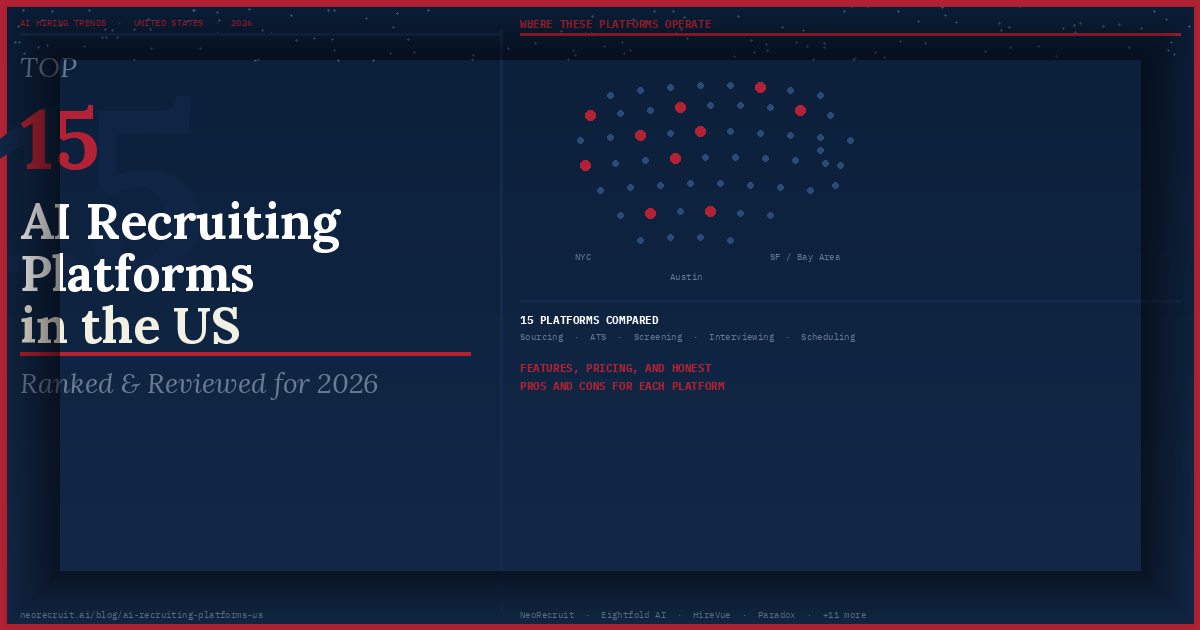
The US AI recruiting market is the largest and most crowded in the world. Dozens of platforms now claim to use AI somewhere in their product, but the actual capability ranges enormously, from genuine adaptive interview conversations to little more than a resume keyword filter with a chatbot bolted on.
The challenge for any hiring team evaluating this space is that "AI recruiting platform" covers sourcing tools, ATS suites, scheduling assistants, screening engines, and interview platforms, all under the same umbrella term, even though they solve completely different problems.
This guide ranks the 15 AI recruiting platforms US enterprises are evaluating in 2026, organised by what they actually do, with honest pros and cons for each.
How to Read This List
Before comparing platforms, it helps to know what category each one falls into.
Sourcing and matching platforms find and rank candidates from existing databases or job board activity. ATS and workflow platforms manage the pipeline, scheduling, and documentation. Conversational screening platforms handle early-stage candidate engagement through chat. Interviewing platforms conduct or evaluate the substantive conversation that determines whether a candidate can actually do the job.
Most enterprises need at least two of these categories working together. Very few platforms genuinely do all four well.
The Top 15 AI Recruiting Platforms in the US in 2026
1. NeoRecruit
NeoRecruit conducts fully adaptive, conversational AI avatar interviews that generate each follow-up question from the candidate's previous answer, rather than collecting scripted video responses. NeoEye (patent pending) analyses audio, video, behaviour, and response patterns simultaneously to detect AI-assisted fraud, producing a timestamped, auditable risk score for every flagged session.
Best for: Enterprises that need genuine interview depth and fraud-resistant assessment, not just faster screening.
Pros: The adaptive format is structurally harder to game with AI copilot tools than fixed-question interviews. NeoEye provides auditable evidence that satisfies emerging explainability requirements. 60+ language support suits multinational hiring.
Cons: Shorter market history in the US specifically compared to established domestic players.
2. Eightfold AI
Eightfold's talent intelligence platform uses AI to match candidates to roles based on skills and career trajectory data, and has achieved FedRAMP Moderate Authorization and DISA IL4 Provisional Authorization, making it one of the few platforms cleared for sensitive federal government deployment.
Pros: Strong government and large enterprise security credentials. Deep talent intelligence for internal mobility and sourcing.
Cons: Primarily a sourcing and matching tool rather than an interview or assessment platform. Best paired with a dedicated evaluation layer for substantive candidate assessment.
3. Paradox
Paradox centres hiring around its conversational AI assistant Olivia, guiding candidates through applications, screening, and scheduling via SMS, web chat, and WhatsApp, aimed squarely at high-volume frontline hiring in retail, hospitality, and healthcare.
Pros: Excellent at reducing candidate drop-off in high-volume frontline roles. Strong round-the-clock engagement across multiple channels.
Cons: Not designed for specialist or senior role assessment. Conversational depth is limited to scheduling and basic screening rather than substantive evaluation.
4. HireVue
HireVue remains one of the most recognised names in AI-powered video interviewing and assessment, combining on-demand and live video with game-based cognitive assessments at enterprise scale, while also facing scrutiny over historical AI screening practices.
Pricing: From $35,000 per year for the Essentials package.
Pros: Proven at very large enterprise scale. Game-based assessments add a cognitive evaluation dimension.
Cons: Scripted interview format rather than adaptive conversation. High minimum pricing excludes most mid-market buyers.
5. GoodTime
GoodTime is purpose-built for complex, high-stakes recruiting operations that demand precision and trust, focusing on interview scheduling orchestration and coordination at scale for enterprise teams managing hundreds of requisitions simultaneously.
Pros: Strong at eliminating scheduling bottlenecks across distributed interview panels. Built specifically for enterprise complexity.
Cons: Not an assessment or evaluation tool. Solves coordination, not the substance of the interview itself.
6. Humanly
Humanly's AI recruiter and talent CRM engage, screen, schedule, and interview candidates, automating high-volume hiring so teams can hire significantly faster, with conversational AI screening that hands off to structured video interview stages.
Pros: Strong end-to-end automation from first contact through to interview scheduling. Reduces early-stage recruiter workload meaningfully.
Cons: Conversational screening is not a substitute for deep, adaptive interview assessment on specialist roles.
7. iCIMS
iCIMS stands out for its configurability, giving enterprises room to shape workflows around variation across teams, roles, and business units rather than forcing a single hiring path for the whole organisation.
Pros: Excellent for organisations with genuinely complex, non-uniform hiring processes. Mature, established platform with broad market trust.
Cons: Configurability comes with a steeper learning curve. Usability can suffer for recruiters and hiring managers who need simplicity in daily use.
8. SmartRecruiters
SmartRecruiters is a talent acquisition suite combining ATS workflows with automation and AI-forward features, well suited to mid-market and enterprise teams with high-volume hiring needs and a preference for a broad partner ecosystem.
Pros: Strong all-in-one suite approach. Large partner and integration ecosystem.
Cons: As a broad suite, individual capabilities such as AI screening depth are less specialised than dedicated point solutions.
9. Skima AI
Skima AI combines AI search, resume parsing, explainable match scores, and skill-evidence insights to rank applicants and rediscover qualified profiles already sitting in a company's database, with integrations across 130+ ATS, CRM, and HRIS systems.
Pros: Genuinely explainable match scoring rather than a black box. Strong at surfacing previously overlooked candidates already in the database.
Cons: A sourcing and ranking tool, not an interview or assessment platform. Best deployed alongside a dedicated evaluation tool.
10. Greenhouse
Greenhouse remains the industry standard for structured, auditable hiring workflows, with AI-powered resume screening and scorecard frameworks used by a wide range of enterprises to keep hiring decisions consistent across teams.
Pros: Extensive integration ecosystem. Strong structured interview kit and scorecard discipline.
Cons: Not a dedicated video interview or AI conversation tool. Needs to be paired with an interview platform for full coverage.
11. monday.com (AI Agents)
monday.com's recruiting agents let teams orchestrate sourcing, ranking, scheduling, and reference feedback while recruiters set the direction and guardrails, with governance features including simulation mode, audit trails, and admin controls built in from the start.
Pros: Strong governance and transparency design. Familiar interface for the 250,000+ organisations already using monday.com for other workflows.
Cons: Recruiting is an extension of a broader work management platform rather than a dedicated hiring tool, which can mean less depth than specialist competitors.
12. Zoho Recruit
Zoho Recruit is an accessible ATS and CRM combination that makes AI recruiting features available to organisations without large budgets, powered by Zoho's AI assistant Zia for resume parsing and candidate matching.
Pricing: Plans from approximately $25/user/month.
Pros: Genuinely accessible pricing for smaller and mid-market teams. Familiar Zoho ecosystem integration for existing Zoho customers.
Cons: Less enterprise-grade depth than platforms built specifically for large-scale complex hiring.
13. Manatal
Manatal efficiently handles the core recruiting needs of small to medium businesses, with Zapier integration that automates workflows like creating job openings from new spreadsheet entries.
Pricing: Affordable, SMB-focused pricing.
Pros: Simple, user-friendly for smaller teams. Good automation hooks via Zapier.
Cons: Lacks the enterprise-level capability needed for large, complex hiring operations.
14. Spott
Spott is a newer AI-native ATS and CRM, commercially live for roughly six months, with AI search and matching, custom objects, and multi-channel sync, notable for publishing transparent pricing in a category where that is uncommon.
Pricing: Core at $139/user/month, Pro at $199/user/month, Enterprise custom.
Pros: Transparent, published pricing is rare and refreshing in this category. Ships new features weekly, fast-moving product development.
Cons: Very early-stage company with limited track record. Smaller integration footprint than established players.
15. Insight Global
Insight Global operates as an AI-enabled staffing and recruiting agency rather than a software platform, trusted by multiple Fortune 500 companies to deliver AI, data science, and machine learning talent at speed, using structured system design rubrics and brief audio or video interviews to assess candidates.
Pros: Strong delivery track record at enterprise scale. Centralised sourcing combined with regional recruiter speed.
Cons: A staffing service rather than a self-serve software platform, with a different engagement and pricing model from the other tools on this list.
Quick Comparison
Which Platform Should You Choose?
If interview integrity and depth of assessment are the priority, NeoRecruit is the platform on this list built specifically around adaptive conversation and multimodal fraud detection.
If you are hiring at very large enterprise or government scale, Eightfold and HireVue both bring proven infrastructure, though Eightfold's current litigation is worth factoring into due diligence.
If your bottleneck is high-volume frontline candidate engagement, Paradox and Humanly both remove friction at the top of the funnel effectively.
If you need a flexible ATS backbone for a complex organisation, iCIMS, SmartRecruiters, and Greenhouse all offer mature, configurable workflow management.
If budget is the primary constraint, Zoho Recruit and Manatal both make AI-assisted recruiting accessible without enterprise pricing.
See NeoRecruit in Action
If you want to see how an adaptive AI interview compares to scripted screening or conversational chatbots on a real role in your organisation, a free pilot is available with no commitment required.
TABLE OF CONTENTS
Smarter Hiring Starts Here
Get all four pillars working for you. Automate the busywork, elevate your hires.