
Top 10 AI Recruiting Trends in 2026: What UK Enterprise HR Teams Are Actually Seeing
From the ICO's Recruitment Rewired report to agentic AI in the hiring funnel, here are the 10 AI recruiting trends UK enterprise HR teams are navigating in 2026 — with what each one actually means in practice.
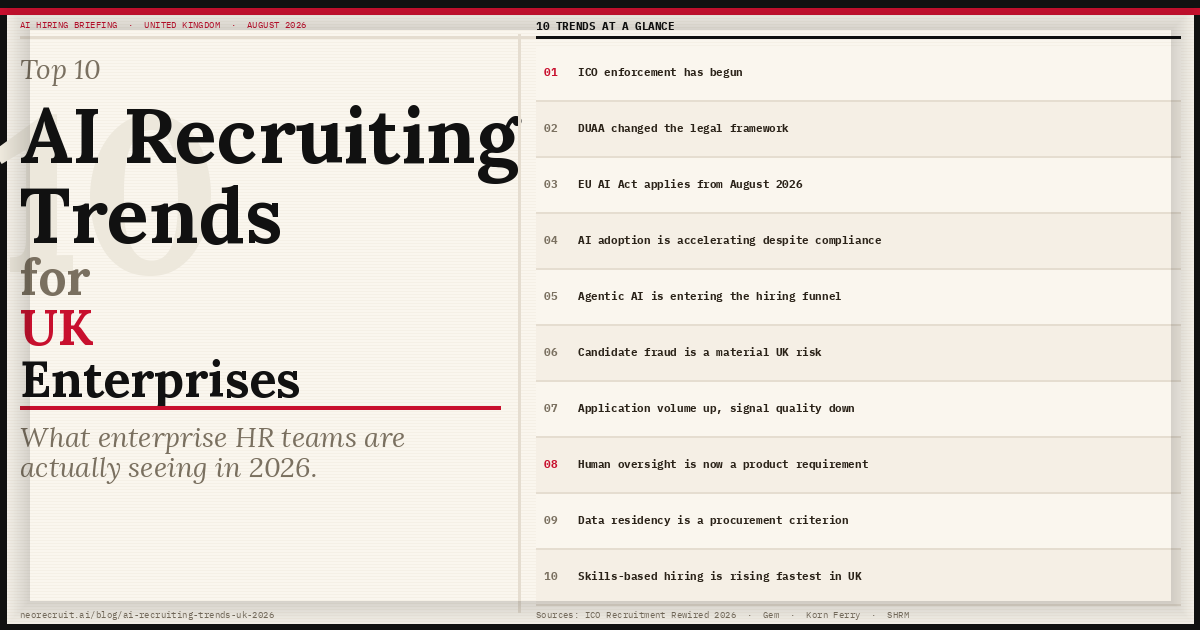
The AI recruiting trends articles being published in 2026 are mostly written for US audiences. They cite LinkedIn surveys, Korn Ferry data, and GoodTime research. They mention the EU AI Act in passing. They do not mention the Information Commissioner's Office, the Data (Use and Access) Act 2025, or the Equality Act 2010 - the three pieces of regulatory infrastructure that make AI recruiting in the UK a fundamentally different conversation from AI recruiting anywhere else in the world.
This article covers the ten trends UK enterprise HR teams are actually navigating in 2026. Not predictions. Not US market data repackaged with a Union Jack. What is happening now, what the regulator has said, and what it means for UK hiring teams in practice.
Trend 1: The ICO Has Started Enforcement - and Most UK Employers Are Not Ready
The single most important development in UK AI recruiting in 2026 has nothing to do with any specific platform. It is the ICO's March 2026 Recruitment Rewired report and its accompanying draft guidance on automated decision-making in recruitment.
The ICO reviewed more than 30 UK employers over a nine-month period. Its headline finding was unambiguous: most organisations using AI to screen and score candidates believed they were merely supporting human decisions when, in practice, the evidence showed those tools were making the decisions outright. Technologyslegaledge
The ICO wrote directly to 16 of those organisations, identifying them as likely operating outside UK data protection law. All 16 committed to act on the regulator's recommendations. This is not a warning shot. It is the beginning of an enforcement cycle.
For UK enterprise HR teams, the practical implication is immediate: if your organisation uses any AI tool to screen, rank, or shortlist candidates, you need to assess whether your current process constitutes automated decision-making under the DUAA, whether your safeguards are documented, and whether your candidate representations mechanisms are in place.
The ICO's position on what does not constitute meaningful human oversight is explicit: a hiring manager who reviews an AI-generated shortlist and approves it without independent analysis has not provided meaningful human review. The candidate has, in regulatory terms, been subject to a solely automated decision. "The algorithm produced the shortlist" is not a defence in an Employment Tribunal. Inside Privacy
Trend 2: The DUAA Has Changed the Legal Framework - But Not Made It Simpler
The Data (Use and Access) Act 2025 came into force on 5 February 2026, replacing Article 22 of UK GDPR with a new framework under Articles 22A to 22D. The change is real and, for many UK employers, helpful. Automated decision-making in recruitment is now permitted in more cases than before, with legitimate interests available as a lawful basis where it previously was not.
But the flexibility is conditional. Four safeguards are now mandatory for any employer using AI to make or materially influence hiring decisions: transparent privacy notices declaring automated decision-making; a candidate representations mechanism; documented meaningful human intervention that goes beyond rubber-stamping; and where special category data is involved, the previous more restrictive rules continue to apply. Neorecruit
The gap between the law and current practice in most UK organisations is significant. Many UK HR teams do not know whether their CV screening tool, their ATS scoring module, or their video interview platform constitutes automated decision-making in the ICO's terms. The answer depends not just on what the tool does but on how the human review layer actually operates in practice, not just on paper.
Trend 3: The EU AI Act Employment Obligations Apply From August 2026
For UK enterprises with operations or hiring activity in the EU, a second compliance layer is active from August 2026. The EU AI Act classifies AI systems used for recruitment, candidate selection, and evaluation decisions as high-risk systems, placing them in the same regulatory category as medical devices and critical infrastructure. Key requirements for high-risk hiring AI include rigorous risk assessments and bias testing, detailed technical documentation explaining how the AI works, human oversight mechanisms, registration in an EU database before deployment, and clear explanations of the AI's role and logic in decisions available to affected candidates. Inside Privacy
The UK and EU frameworks have diverged. The EU AI Act and UK GDPR apply concurrently: AI Act compliance does not automatically satisfy GDPR obligations, and GDPR compliance does not meet AI Act requirements, although measures taken to comply with each regime will often overlap. For UK enterprises hiring across both jurisdictions, the compliance architecture needs to address both simultaneously. Inside Privacy
Trend 4: AI Adoption in UK Recruiting Is Accelerating Despite Compliance Pressure
UK SME AI adoption reached 54% by March 2026, with the Data (Use and Access) Act 2025 coming fully into force on 5 February 2026. Recruiting is one of the functions seeing the fastest adoption, with AI tools being deployed across every stage of the hiring lifecycle from CV filtering and suitability scoring to online assessments and behavioural analysis.
The adoption is not slowing because of the compliance landscape. It is accelerating despite it. The efficiency gains are too significant for most hiring teams to ignore. The organisations navigating this well are not the ones that paused AI adoption while waiting for regulatory certainty. They are the ones that understood the compliance framework clearly enough to deploy AI within it, with the safeguards in place from the start rather than retrofitted after a regulator's letter arrives.
Trend 5: Agentic AI Is Entering the UK Hiring Funnel
The broader AI trend of 2026, AI agents that act autonomously rather than waiting for prompts, is beginning to appear in recruiting workflows. More than half of talent leaders globally are planning to add autonomous AI agents to their recruiting teams this year according to Korn Ferry's 2026 research.
In the UK context, this creates a specific compliance question that most agentic AI vendors are not yet addressing clearly: at what point in an agentic workflow does a significant decision about a candidate occur, and who is responsible for the mandatory safeguards around that decision?
An automated decision, in the DUAA sense, is a significant decision about a person made by a system without meaningful human involvement. The threshold is the decision, not the headcount. An AI agent that reads a job description, screens CVs, and books interview slots is making or influencing multiple decisions about multiple candidates autonomously. UK hiring teams evaluating agentic recruiting tools in 2026 should apply the ICO's own framework: any autonomous screening or rejection decision that operates without genuine human review of each individual case is likely to require the full Article 22C safeguards. Global Policy Watch
Trend 6: Candidate Fraud Has Become a Material Risk in the UK Job Market
The compliance conversation in UK AI recruiting has focused almost entirely on employer obligations toward candidates. The parallel problem, candidates using AI to misrepresent their capability during hiring processes, has received less regulatory attention but is operationally significant for UK hiring teams.
CodeSignal data from 2026 found that cheating on technical assessments doubled in a single year, from 16% to 35%. Anthropic publicly acknowledged rewriting its own technical interview questions because candidates were using AI to generate answers during interviews. The tools candidates are using, including invisible overlay software that generates real-time answers without being detected by standard proctoring, were specifically engineered to bypass the monitoring approaches that most video interview platforms rely on.
For UK hiring teams, this creates a compound problem. The compliance framework requires human oversight of AI-influenced decisions affecting candidates. Simultaneously, the candidate fraud landscape requires better verification of whether the person performing in an interview is genuinely capable of the role being assessed. Both problems require more rigour in the interview layer, not less.
Trend 7: Application Volume Has Surged While Signal Quality Has Fallen
UK hiring teams are managing application volumes that have increased significantly without a corresponding increase in qualified candidate density. Gem's 2026 Recruiting Benchmarks Report found a 93% surge in application volume across markets, driven partly by AI-assisted application tools that have lowered the friction of applying to multiple roles simultaneously.
LinkedIn data shows 73% of HR professionals say less than half of the applications they receive meet all the criteria for the role. The noise-to-signal ratio is worsening at the same time that recruiter capacity in many UK organisations is under cost pressure following headcount reductions in TA functions.
The response most effective UK hiring teams have adopted is moving genuine assessment earlier in the funnel, automated at the volume the application surge requires, so that recruiter time is spent on a verified shortlist rather than a raw application pile.
Trend 8: Meaningful Human Oversight Has Become a Product Requirement, Not Just a Compliance Checkbox
One of the most significant practical shifts in UK AI recruiting in 2026 is the move toward hiring tools that generate structured, auditable evidence of human oversight rather than tools where the oversight record depends on a recruiter remembering to document it.
Meaningful human involvement means human review by a competent person who has the authority, information, and time to overturn the tool's output and who actually considers the individual case. The ICO is clear that two things do not count: designing or building the system, and rubber-stamping its output. Global Policy Watch
For UK HR teams, this translates into a product requirement: any AI tool used in a decision that significantly affects a candidate must produce a documented record showing that genuine human review occurred.
NeoRecruit addresses this directly. The platform produces a score and structured reasoning for each candidate session, with timestamped evidence. The hiring decision, whether to advance or reject a candidate, is always made by a human reviewer, never by the system itself. The output is designed to give the human reviewer enough structured information to make a genuine independent judgment, which is precisely what the ICO requires, and to document that review in a form that satisfies audit requirements.
Trend 9: Data Residency and International Transfer Risk Have Become Procurement Criteria
A practical consequence of the post-Brexit UK GDPR landscape is that UK hiring teams are increasingly scrutinising where candidate data collected during recruitment is hosted and processed.
Transferring personal data outside the UK requires either an adequacy decision or appropriate safeguards such as a UK International Data Transfer Agreement. Many AI hiring tools, particularly those built and hosted in the United States, require buyers to establish these safeguards independently. The ICO has been explicit that this transfer risk needs to be assessed at the procurement stage, before contracts are signed, and that a DPIA must be completed before procuring or deploying any AI hiring tool - ideally before signing anything. Privacy Matters
Purchasing a platform without native UK DUAA and GDPR compliance built into the architecture is now considered commercial negligence for UK buyers. The days of buying a US-centric platform and trying to bolt on compliance later are over. For any platform without UK or EU hosting, UK buyers should ask for a Data Processing Agreement, a UK International Data Transfer Agreement, and documentation of where candidate data is stored and for how long.
Trend 10: Skills-Based Hiring Is Growing Faster in the UK Than Anywhere Else in Europe
The shift from credentials-based to skills-based hiring has been discussed globally for several years. In the UK in 2026, it is accelerating faster than in comparable European markets, driven by a combination of factors: the post-Brexit skills shortage in specialist technical roles, the AI displacement of junior positions that traditionally fed the mid-level candidate pipeline, and the growing recognition that a CV is no longer a reliable signal in a market where AI can optimise it.
Skills-based hiring has become the top priority for businesses this year according to SHRM research, with 43% of businesses making it their primary hiring focus. For UK enterprises, this is both a talent acquisition strategy and a compliance strategy. Hiring on demonstrated skills rather than credentials or CV keyword matches reduces the risk of discrimination claims under the Equality Act 2010, since skills-based criteria are more defensible as genuine occupational requirements than education or experience proxies that may correlate with protected characteristics.
The practical challenge is that genuine skills assessment at the volume UK hiring teams need requires AI assistance. The tools that enable skills-based hiring at scale in a UK-compliant framework are those that produce verifiable, structured assessment output from a consistent evaluation process applied to every candidate, with human review of the output before any hiring decision is made.
What This Means for UK Enterprise HR Teams in Practice
Ten trends, but three practical actions that cut across all of them.
First, audit your AI tools against the ICO's framework now. Do not wait for a letter. The ICO has already written to 16 UK organisations and committed to enforcement. Map every AI-assisted step in your hiring process and assess whether it constitutes automated decision-making in the ICO's terms, whether your safeguards are documented, and whether your candidate privacy notices are accurate.
Second, assess your human oversight records. For any AI-influenced hiring decision, can you produce documented evidence that a competent human genuinely reviewed the individual case? If the answer is that a hiring manager approved an AI-generated shortlist without independent review, you are not compliant under the ICO's current guidance.
Third, apply data residency scrutiny at procurement. Any new AI hiring tool you evaluate should be assessed on where candidate data is hosted, what international transfer safeguards are in place, and whether the vendor can produce GDPR documentation that satisfies UK ICO requirements, not just US privacy framework compliance.
The UK AI recruiting market in 2026 is not simply a version of the global AI recruiting market. It is operating under a specific regulatory framework, enforced by an active regulator, with compliance requirements that go beyond anything US-origin content on this topic typically addresses. The hiring teams navigating it well are the ones that treat compliance and capability as the same question rather than treating them as separate concerns.
Book a free pilot at neorecruit.ai
Related reading:
TABLE OF CONTENTS
Smarter Hiring Starts Here
Get all four pillars working for you. Automate the busywork, elevate your hires.