
The Lean Recruiter Era: Why Talent Teams Are Drowning in Applications With Fewer People to Read Them
Hiring is up 8.3% but recruiter headcount is down 14%, and application volume has surged 93%. Here is what is actually happening inside talent acquisition teams in 2026, and what changes the equation.
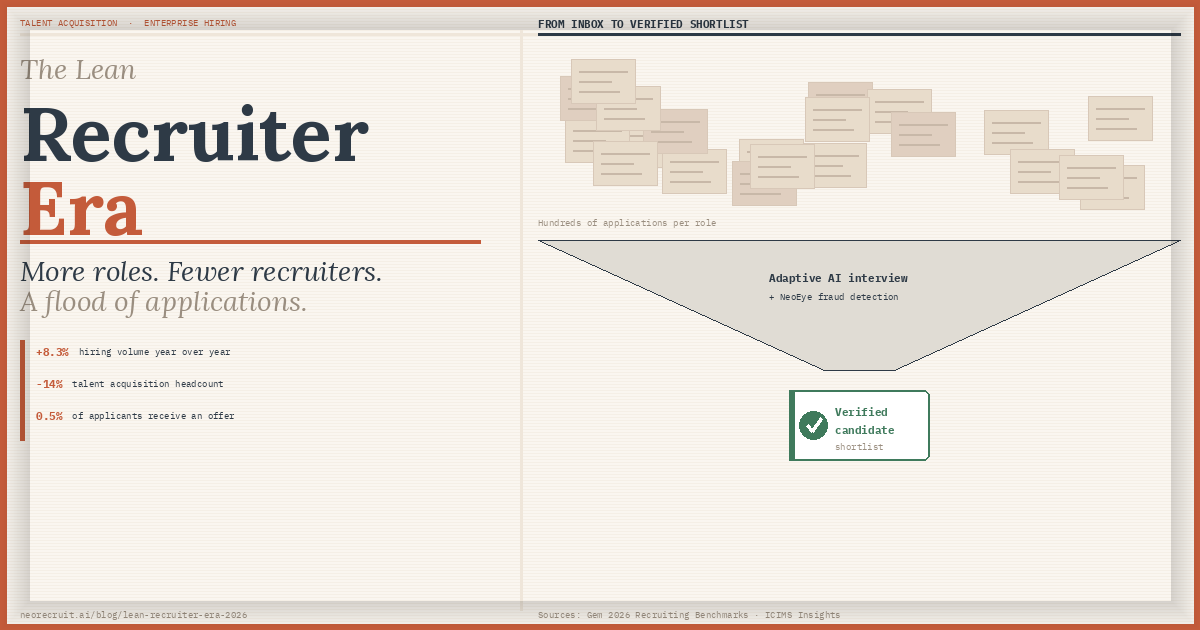
If you work in talent acquisition in 2026, you have probably noticed something that does not add up. Hiring is supposedly recovering. Job openings are at multi-month highs. And yet your team has never felt more stretched, your inbox has never been fuller, and the gap between candidates applying and candidates actually getting hired has never felt wider.
The data confirms what the feeling already told you.
According to Gem's 2026 Recruiting Benchmarks Report, aggregate hiring is up 8.3% year over year. But talent acquisition teams are operating with 14% less headcount than they had during the hiring booms of a few years ago. Recruiters are facing a 93% surge in application volume, and only 0.5% of applicants ultimately receive a job offer. CV Made Better
Separately, ICIMS Insights data from over 691 million candidate profiles shows that in April 2026, job openings hit a 12-month peak at 15% above baseline, while hiring velocity flatlined at 0% growth. GraffersID
Read those together and the picture becomes clear. More roles are open. Fewer recruiters are working them. Each role is attracting a flood of applications, most of which are not meaningfully reviewed, and the rate at which any of this converts into an actual hire has stalled completely.
This is the lean recruiter era. And it is reshaping what "screening" actually means inside enterprise hiring teams, often in ways nobody has explicitly decided.
What "Screening" Actually Looks Like Today
The honest starting point is acknowledging how little time any single application receives.
A 2024 ResumeGo survey of 418 hiring professionals found that 81% of recruiters spend less than a minute on a CV during initial screening, and only 1% spend less than 10 seconds. A typical corporate recruiter manages 15 to 25 open roles simultaneously, and in the current environment it is not unusual to receive 300 to 500 applications per role, meaning a recruiter could have over 12,000 resumes to review at any given time. QureosGoperfect
Even at a rapid pace of 30 seconds per application, reviewing 300 applications for a single role consumes at least 8 hours of dedicated effort, before any candidate outreach or interviews begin. Fabric
Now multiply that by the 93% application surge Gem documented, while removing 14% of the people who were doing that reviewing. The math does not work. It was never going to work. What happens instead is that screening gets shallower exactly when the candidate pool is becoming harder to evaluate.
LinkedIn data shows 73% of HR professionals say less than half of the applications they receive meet all the criteria for the role. The noise-to-signal ratio is worsening at the same time the capacity to filter it is shrinking. Deloitte
The 0.5% Number Is Not a Quality Signal
It is tempting to read "0.5% of applicants receive an offer" as evidence that the bar for hiring has become extremely high, that only the very best candidates are getting through.
That is not what is happening. A 0.5% conversion rate with 81% of resumes receiving under a minute of attention is not a high bar. It is a bandwidth ceiling. The candidates who do not get an offer are not necessarily the wrong candidates. They are candidates who were never genuinely evaluated, because the volume made genuine evaluation for every applicant mathematically impossible.
This matters because of what it implies about the candidates who do make it through. If the screening that determines who advances is happening in seconds, based on keyword density and resume formatting, the candidates who reach the interview stage were selected for how well their CV was constructed, not necessarily for how well they can do the job. With only 19% of entry-level job seekers reporting they feel very confident in their careers, and 44% citing job security as a top priority, candidates are responding to this environment by optimising their applications for the filter rather than for the role. GraffersID
The result is a funnel where the input is noisy, the filter is shallow, and the output is a small number of candidates who were good at being filtered, not necessarily good at the job.
Why Adding Recruiters Is Not the Answer
The intuitive fix is to hire more recruiters or restore headcount to previous levels. But talent acquisition teams operating with 14% less headcount are not necessarily going to get that headcount back. Recruiting functions, like every other function, are under cost pressure, and the business case for adding recruiters to handle application volume that AI tools partly created in the first place is a difficult one to make to finance leadership. CV Made Better
There is also a more fundamental problem. Even with more recruiters, the 7 to 60 second screening window is not where genuine signal lives. The candidates who pass that initial filter then receive a closer second look, but by then the funnel has already discarded the vast majority of applicants based on a few seconds of attention. Adding more people to do more of this faster does not change what is being measured. It is still a CV, reviewed quickly, against criteria that a CV cannot fully demonstrate. Gulf News
The structural fix is not more capacity at the existing stage of the funnel. It is moving genuine assessment to a stage where it can happen automatically, consistently, and at the volume the funnel now requires, so that the recruiters who remain are reviewing a verified shortlist rather than a raw application pile.
Where NeoRecruit Fits in the Lean Recruiter Funnel
This is the specific gap NeoRecruit is built to close.
In a lean recruiter funnel, the stage that has effectively disappeared is genuine evaluation between the CV scan and the final interview. NeoRecruit's adaptive AI avatar conducts that evaluation directly, at the volume the application surge requires, without adding headcount.
Every candidate who passes initial CV screening can be invited to a live, adaptive interview conducted by NeoRecruit's AI avatar, available 24/7 with no scheduling required. The avatar speaks, listens, and generates each follow-up question from what the candidate said in their previous answer, the way a skilled interviewer would. A candidate who claims experience leading a migration project gets asked about the specific constraints of that migration. A candidate who describes a technical decision gets asked why they chose that approach over the alternatives.
This produces something the 7-second resume scan cannot: a structured, comparable assessment of how each candidate actually reasons, generated automatically across hundreds of candidates without consuming recruiter time. By the time a human reviews the shortlist, they are looking at candidates who have already demonstrated genuine capability in conversation, not candidates who were simply good at writing a CV.
For a recruiter managing 15 to 25 open roles and thousands of resumes, this changes what their day looks like. Instead of spending 8 hours scanning 300 resumes for one role, they review a shortlist of candidates who have already been substantively assessed, with a structured rationale for each one. Clients using NeoRecruit report 90% time saved in pre-screening and 5x more candidates evaluated per hiring cycle, which is precisely the kind of leverage a 14% smaller team needs against a 93% larger inbound volume.
The Cheating Problem Hiding Inside the Volume Problem
There is a second-order effect of the lean recruiter era that deserves attention. AI use across HR tasks climbed to 43% in 2026, up from 26% in 2024, on both sides of the table. Candidates are using AI to apply faster and to prepare for interviews. Recruiters are using AI to screen faster. Both sides are automating, and the interaction between those two automations is where assessment integrity breaks down. Zawya
A candidate who has used AI to optimise their CV against the keywords your screening tool looks for, and who then uses an AI copilot during a video interview to generate polished answers in real time, can pass through a high-volume, low-touch funnel without ever having their genuine capability tested. In a well-staffed funnel with deep human review at every stage, this candidate might eventually be caught. In a lean funnel where every stage is compressed, they are more likely to slip through.
This is precisely the problem NeoEye (patent pending) is designed to catch.
NeoEye operates as a second layer on top of NeoRecruit's adaptive interview. While the adaptive format already makes AI-assisted cheating structurally difficult, because the AI avatar generates each follow-up question from the specific content of the candidate's previous answer rather than from a fixed script, NeoEye analyses audio, video, behaviour, and response patterns simultaneously throughout the session.
It looks for the signals that distinguish a candidate genuinely reasoning in real time from a candidate reading or reciting AI-generated content: unnatural pauses that correspond to the latency of generating a response, inconsistencies between what was said earlier in the conversation and what is said later, behavioural patterns that do not match natural conversational rhythm, and audio or visual anomalies that suggest external assistance.
When NeoEye flags a session, it does not produce a simple pass or fail. It generates a structured risk score with timestamped evidence, showing exactly which moments in the interview triggered the flag and why. This means a recruiter reviewing a flagged candidate is not taking the system's word for it. They are looking at the same evidence the system used, and can make their own judgment, which satisfies the human oversight requirements increasingly required under the UK DUAA, EU AI Act, and similar frameworks.
In a lean recruiter funnel, this matters more, not less. When a recruiting team has less time to scrutinise any individual candidate, the candidates who reach the final stages need to have already been verified, not just screened. NeoEye provides that verification automatically, at the same scale as the adaptive interviews themselves, so that the reduction in recruiter capacity does not become a corresponding increase in candidate fraud risk.
What This Looks Like End to End
Put together, here is what the lean recruiter funnel looks like with NeoRecruit in place.
A role goes live and attracts hundreds of applications, consistent with the 93% volume surge documented across the market. CV screening filters for baseline fit, the stage that AI tools already handle reasonably well. Candidates who pass are automatically invited to an adaptive AI interview with NeoRecruit, available immediately, with no scheduling coordination required from the recruiting team.
Each candidate completes a real conversation, not a recorded one-way video, with questions generated from their own answers. NeoEye analyses the session in parallel, generating a risk score and timestamped evidence for any session showing signs of AI-assisted cheating. The recruiter receives a shortlist of candidates with structured assessment scores and integrity flags already resolved, ready for final-round human interviews.
The recruiter's time, the scarcest resource in the lean recruiter era, is spent entirely on candidates who have already demonstrated genuine capability and have been verified as the person actually answering. Nothing about this requires the recruiting team to grow. It requires the assessment stage of the funnel to do the work that volume has made impossible for humans to do alone.
The Bottom Line
The lean recruiter era is not a temporary blip that resolves when budgets loosen. Aggregate hiring is up while headcount is down, and the application volume increase is structurally tied to AI adoption on the candidate side, which is not reversing. The 0.5% offer rate is a symptom of a funnel that has not adapted to its own inputs. CV Made Better
The talent teams that will function well in this environment are not the ones waiting for headcount to be restored. They are the ones who have moved genuine, verified assessment to a stage of the funnel where it can scale automatically, freeing their recruiters to do the part of the job that genuinely requires a human: building relationships with candidates who have already proven they deserve the time.
TABLE OF CONTENTS
Smarter Hiring Starts Here
Get all four pillars working for you. Automate the busywork, elevate your hires.