
Why Hiring Is Getting Harder Even as Applications Rise: The Two-Tier Talent Market of 2026
Applications are up. Hiring is harder. The 2026 talent market has split into two distinct tracks and most enterprise hiring teams are using the wrong tools for both. Here is what is actually happening.
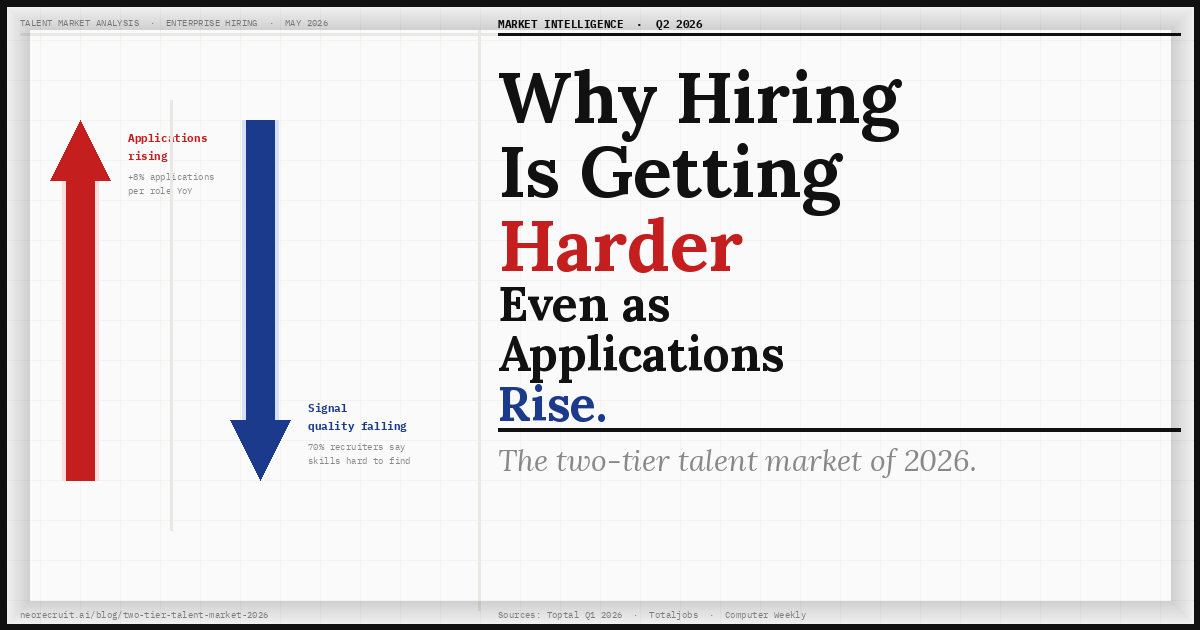
Something counterintuitive is happening in the 2026 talent market. Applications are rising. Hiring is getting harder.
For most enterprise HR leaders, this feels wrong. More candidates should mean more options. More resumes should mean more signal. In practice, the opposite is happening. Inboxes are fuller and shortlisting is slower, more contested, and less reliable than it was three years ago.
Understanding why requires accepting that the talent market has split into two distinct tracks that are moving in opposite directions simultaneously. The tools, instincts, and processes built for one track are increasingly ineffective on the other. And most enterprise hiring teams have not yet adjusted.
The Two Tracks
New data from Toptal's Q1 2026 High-skilled Job Report shows demand for experienced remote and hybrid technology and professional services workers increased 8.9% quarter over quarter and 4.8% year over year. At the same time, overall job postings across major economies continued falling, declining roughly 3% quarter over quarter and 8% year over year across the US, UK, Canada, France, Germany, and Ireland. Withsherlock
Read those two numbers together. Demand for specialist talent is growing at nearly 9% quarterly. Overall hiring is shrinking at 8% annually. The same labour market is producing both trends simultaneously.
The labour market is increasingly dividing between weaker overall hiring conditions and continued demand for highly specialised workers connected to AI-driven business transformation. Companies are increasingly hiring for roles tied to AI deployment, automation, and digital transformation while becoming more selective about who they bring on. Demand is growing most strongly for experienced workers with technical expertise, AI fluency, business judgment, and communication skills. Withsherlock
This is the two-tier market. Track one is broad, general hiring covering volume roles across operations, administration, and junior positions, where supply is exceeding demand significantly. Track two is specialist hiring across AI engineers, cloud architects, cybersecurity professionals, data scientists, and senior product managers, where demand is structurally outpacing supply.
Most enterprise hiring teams are running the same process on both tracks. That is the core problem.
Why Applications Rising Does Not Mean Signal Rising
70% of recruiters say finding candidates with the right skills is a challenge, making skills-based hiring the top priority for businesses in 2026. Improving applicant quality ranked third among recruiter priorities, above sourcing volume. Arab News
The application volume increase is real but it does not represent a proportionate increase in qualified candidates. Three forces are driving it.
First, agentic AI is displacing jobs at junior to mid-levels, particularly in white-collar roles, while skilled trades and senior specialists remain largely insulated. The candidates displaced from junior positions are applying upward for mid-level and specialist roles they may not yet be equipped for, increasing application volumes at those levels without increasing the pool of genuinely qualified candidates. Jadeer
Second, AI application tools have dramatically lowered the friction of applying. A candidate who in 2022 would apply to 10 relevant roles now applies to 50 with comparable effort. 70% of job seekers use generative AI to research companies, draft cover letters, and prepare for interviews. The CV arriving in your ATS has been optimised to pass keyword screening. The candidate behind it may or may not be a genuine match. GraffersID
Third, 38% of employed US workers intend to look for a new role in the first half of 2026, up from 29% a year ago. A larger proportion of the workforce is actively searching, which means more applications per role even from candidates who are not urgently motivated and may not convert. HeroHunt
The result is a paradox that every hiring manager recognises immediately when it is described: more applications, worse shortlists. The volume is up. The signal is down.
The Specialist Shortage Is Structural, Not Cyclical
The challenge on Track 2 - finding genuine specialist talent is not something that will resolve when the economy shifts. It is structural.
Global IT spend will increase by nearly 10% in 2026, far exceeding GDP growth in most major economies. Demand hotspots for specialist tech skills including AI, data, enterprise applications, and cybersecurity are outpacing supply significantly. Inc. Arabia English
Starting salaries for specialist roles increased at the fastest pace in nearly 18 months due to continued shortages in skilled talent. When salaries are rising fastest at exactly the point where supply is tightest, the market is signalling that the shortage is not temporary. Employers are not finding their way to equilibrium through pricing. They are paying more for the same insufficient pool. Qureos
The roles at the centre of this shortage share a common characteristic: they require capabilities that cannot be quickly taught or credentialled. An LLM engineer with three years of production experience in a regulated financial services environment does not become available faster because you raise the salary offer by 20%. The experience has to exist somewhere, and right now there is not enough of it.
The quality-signal problem is among the most pressing challenges in specialist hiring in 2026. Buyers are now asking whether their talent partners are documenting and governing their AI use, and that is becoming a vendor selection factor. CV Made Better
What Standard Screening Tools Were Built For
Applicant Tracking Systems were designed for Track 1. High-volume inbound applications, keyword filtering, pipeline stage management, scheduling coordination. At processing volume at speed, modern ATS platforms are genuinely good.
The problem is that Track 1 tools applied to Track 2 problems produce Track 1 outputs: a filtered list of candidates who know what keywords to put on a resume, not a verified shortlist of candidates who can actually do the job.
Keyword screening for an AI engineering role will surface every candidate who has written "LLM", "transformer architecture", and "MLOps" in their resume. It will not distinguish between the candidate who has run production LLM systems at scale and the candidate who completed an online course last quarter. That distinction is the entire hiring decision for a role where the salary premium is 30 to 60% and the cost of a wrong hire is months of lost output.
Skills-based hiring is the top recruiter priority for 2026, with 43% of businesses making it their primary focus. 58% of businesses are confident they will hire the talent they need - which means 42% are not. Arab News
The 42% who are not confident are largely those still trying to solve a Track 2 problem with Track 1 tools.
Where Assessment Quality Becomes the Differentiator
The organisations winning the specialist talent competition in 2026 have made one structural change that the others have not: they have moved genuine capability assessment upstream.
In the traditional funnel, substantive assessment of whether a candidate can actually do the job happens at the final interview stage, after multiple rounds of screening and coordination have already been invested. By that point, the candidate has multiple offers and the assessment is partly a formality.
Moving adaptive, substantive assessment earlier in the funnel changes the economics of specialist hiring significantly. Hiring teams spend less time on candidates who will not convert and more time on those who will. The signal available at the shortlisting stage is genuine capability evidence rather than keyword match scores. And the candidates who reach the final stage have already demonstrated their reasoning, not just their ability to describe it.
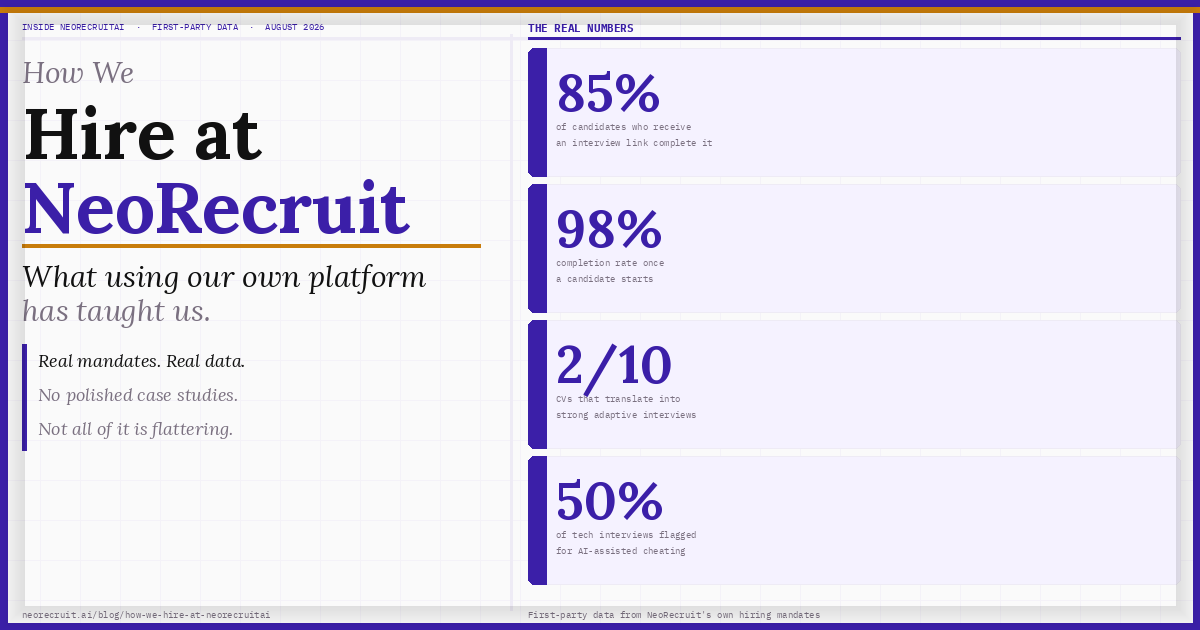
This is precisely what NeoRecruit's adaptive AI interview is designed to produce at scale. Rather than collecting scripted video responses or text chat answers to fixed questions, the AI avatar generates each follow-up question from what the candidate said in their previous answer - probing the specific reasoning behind a specific decision the candidate described. The assessment cannot be gamed by polishing a fixed answer because the next question depends on the specific content of the previous one.
The result is assessment signal that standard screening cannot generate: verified evidence of how a candidate reasons under probing, not how well they have prepared for predictable questions.
For specialist hiring specifically - where the candidate pool is thin, the cost of a wrong hire is significant, and the assessment bar is the entire quality-of-hire decision - moving this quality of assessment earlier in the process is not a process refinement. It is a structural competitive advantage.
Clients using NeoRecruit report 90% time saved in pre-screening and 5x more candidates evaluated per hiring cycle - which means hiring teams are not choosing between speed and quality. They are getting both by changing where in the funnel the real assessment happens.
What Enterprise Hiring Teams Should Do Differently
The two-tier market requires two distinct approaches, not one unified process applied to everything.
For Track 1 - volume roles: Invest in ATS efficiency, job board coverage, and automated screening that filters on demonstrated skills rather than keywords. The priority is reducing noise in the inbound pipeline, not deepening assessment at the early stage.
For Track 2 - specialist roles: Invest in assessment quality earlier in the funnel. Many employers are prepared to pay higher salaries to candidates with advanced skills but are not investing proportionately in the assessment infrastructure to verify those skills exist before the offer is made. The salary premium is paid. The verification is not done. That gap is where wrong hires happen. HeroHunt
Specifically for Track 2:
Move adaptive interview assessment to the post-application stage rather than reserving it for final rounds. The candidates you lose while running four weeks of coordination-heavy screening are the ones who had three other offers.
Stop using keyword-matched screening as a proxy for capability on specialist roles. A resume is a marketing document, and in 2026 it is an AI-assisted one. It tells you what the candidate wants you to believe. A structured, adaptive interview tells you what they can actually demonstrate.
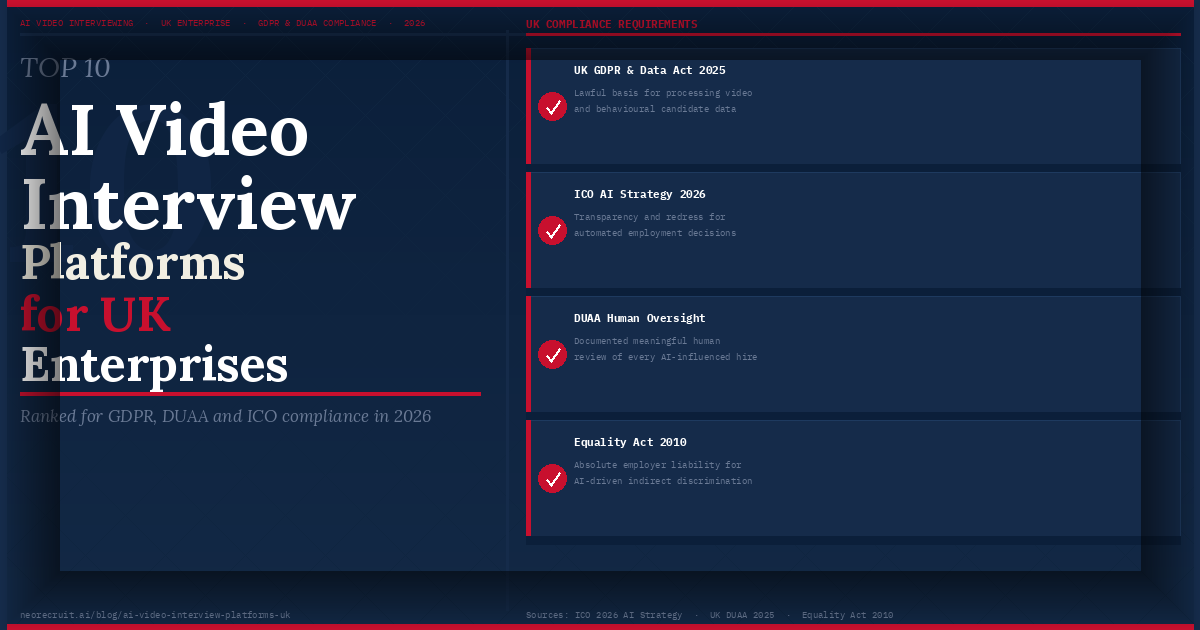
Build your audit trail for specialist hires. The regulatory environment is moving toward mandatory explainability for automated hiring decisions across the UK, EU, and GCC. Every hiring decision that cannot be documented is a future liability.
The Honest Summary
The talent market is not simply competitive. It is structurally bifurcated in a way that makes a single hiring approach increasingly ineffective.
Global unemployment is projected to remain stable at 4.9% in 2026, but beneath the surface, the broader jobs gap capturing people who want paid work but cannot access it is projected to reach 408 million. Progress in job quality has stalled and labour markets are increasingly exposed to technological disruption. Themiddleeastinsider
For enterprise hiring teams, the practical implication is clear. The tools and instincts that worked when the market was uniform are not sufficient when it is split. Volume screening solves a volume problem. It does not solve a capability verification problem.
The organisations that will build the strongest specialist teams through this market are not those with the largest ATS databases or the most job board subscriptions. They are those that assess genuine capability earlier, faster, and more reliably than their competitors and make hiring decisions based on verified evidence rather than polished CVs.
Book a free pilot at neorecruit.ai
Related reading:
TABLE OF CONTENTS
Smarter Hiring Starts Here
Get all four pillars working for you. Automate the busywork, elevate your hires.