
NeoRecruit vs Sapia.ai: Which AI Interview Platform is Right for Your Enterprise?
NeoRecruit vs Sapia.ai: compare AI interview formats, fraud detection, language support, and which platform fits your enterprise hiring needs in 2026.
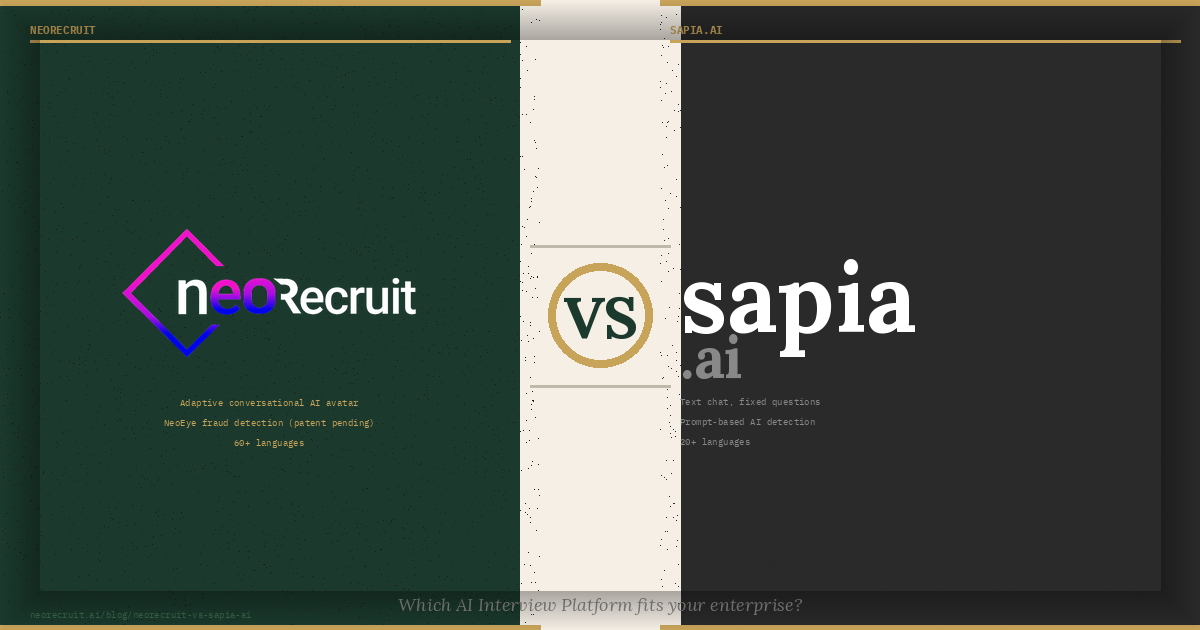
NeoRecruit and Sapia.ai are both AI interview platforms. Both are used by enterprise hiring teams. Both claim to screen candidates faster, more fairly, and at greater scale than traditional interviews. But they were built on different assumptions about what the core problem in hiring actually is, and those assumptions produce genuinely different products.
This comparison covers what each platform does, where each is strongest, where each falls short, and which type of organisation each is built for. It is written to help hiring teams make an informed decision, not to declare a winner.
What Sapia.ai Does
Sapia.ai is an AI hiring platform designed to help enterprises streamline their recruitment processes by enabling them to interview a larger pool of candidates more efficiently. Its unique approach combines inclusive, conversational assessments with validated AI technology to facilitate a hiring process that is not only quicker but also fairer and more enjoyable for candidates. Elatestaff
The SAIGE engine powering the platform has learned from over 8 million real interviews across industries and role types. It understands not just what candidates say, but what their responses reveal about their potential. Every assessment applies validated behavioural science. Every recommendation is backed by real outcomes. Every decision is explainable to candidates, regulators, and leadership teams. Transparent
The core product is a text-based chat interview. Candidates receive a structured set of questions and respond in free text at their own pace, on any device, without requiring video or audio capability. The platform has been adopted by notable enterprises such as Qantas, Holland and Barrett, BT Group, and Costa Coffee, who have reported significant reductions in time-to-hire as well as improved employee retention rates. Elatestaff
Using Sapia.ai, Woolworths interviews one million people per year and hires 50,000, achieving a candidate satisfaction score of 9 out of 10. Gem
Sapia.ai's philosophy is that removing video reduces bias, lowers candidate anxiety, and improves accessibility for neurodiverse applicants and those without reliable internet or camera access. The platform gives every candidate feedback on their interview, which is unusual in enterprise hiring and a meaningful differentiator for employer brand.
What NeoRecruit Does
NeoRecruit is an AI-first hiring platform built around adaptive conversational interviews. Rather than presenting a fixed set of questions, its AI avatar speaks, listens, and generates each follow-up question based on what the candidate said in their previous answer, the way a skilled human interviewer would.
This adaptive format produces two outcomes that fixed-format chat interviews cannot. First, it generates a deeper quality of assessment signal - the follow-up questions probe the specific reasoning behind a specific decision the candidate described, not a generic competency prompt. Second, it makes AI-assisted cheating structurally harder. A candidate using an AI copilot tool during a chat interview can paste a question into the tool and read back a generated answer. When the next question is generated from what the candidate just said, the AI copilot has no prepared answer and the latency of generating one in real time is detectable.
NeoEye (patent pending) sits on top of this as a second detection layer, analysing audio, video, behaviour, and response patterns simultaneously to generate a structured risk score with timestamped evidence for every flagged session.
NeoRecruit supports 60+ languages including Arabic and regional Indian languages, making it operationally effective across the GCC, South Asia, and Southeast Asia in ways that text-only platforms are not.
Clients report 90% time saved in pre-screening and 5x more candidates evaluated per hiring cycle.
Interview Format: The Core Difference
This is where the two platforms diverge most meaningfully.
Sapia.ai: text chat, fixed questions
Sapia.ai constructs a structured interview with five questions needed to get the talent you are looking for. When the AI interviews applicants, it uses only text responses for its analysis. Every candidate receives the same questions in the same sequence. The SAIGE engine scores responses against a validated competency model. Gem
The strength of this approach is accessibility and consistency. A candidate in a remote area with a slow connection and no camera can complete the interview on their phone in their own time. The scoring is consistent across every candidate. The format is low-anxiety and has produced exceptionally high completion rates.
The limitation is that fixed questions are scriptable. A candidate who has researched the role can prepare polished answers in advance, and in 2026 can use AI tools to generate those answers in real time. Sapia.ai's own position on this is that what matters most is whether someone can demonstrate the required competencies, and their system prompts rather than penalises if AI usage is detected. This is a reasonable philosophy for high-volume frontline roles where the screening bar is primarily about culture fit and baseline communication. It is a more significant limitation for technical, specialist, or senior roles where the integrity of the assessment matters more.
NeoRecruit: adaptive conversational AI avatar
NeoRecruit's interview is a live conversation. The AI avatar speaks and listens. Each question is generated from the previous answer. The interview feels, to the candidate, like talking to a thoughtful interviewer rather than filling in a form.
This produces richer assessment signal for roles requiring genuine reasoning evaluation. The candidate cannot rehearse for an interview where each question depends on what they say first. The format is harder to game with AI assistance because the assistance has to work in real time against dynamically generated questions.
Anti-Cheat and Interview Integrity
This is the sharpest point of difference between the two platforms.
Sapia.ai's system may prompt during interviews if AI usage is detected, but this is guidance, not penalisation. The philosophy is that what matters most is whether someone can demonstrate the required competencies. Elatestaff
NeoRecruit's position is structurally different. The adaptive interview design makes AI assistance significantly harder to use effectively in the first place. NeoEye then provides multimodal detection covering audio, video, behaviour, and response patterns simultaneously, generating a timestamped risk score with auditable evidence for every flagged session.
For enterprise hiring teams where assessment integrity is a governance requirement, the distinction matters. A financial services GCC hiring for compliance roles, a technology company hiring for senior engineering positions, or any organisation that needs to demonstrate to global headquarters that its assessment process is fraud-resistant needs more than a prompt. It needs auditable evidence.
For high-volume frontline or operational roles where the fraud risk is lower and the primary concern is screening efficiently at scale, Sapia.ai's approach is practically sufficient.
Language and Market Coverage
Sapia.ai supports more than 20 languages and has strong enterprise adoption across Australia, the UK, and the United States. Its text-based format is inherently more accessible for candidates with limited audio or video capability regardless of language.
NeoRecruit supports 60+ languages including Arabic and regional Indian languages, making it the stronger choice for organisations hiring across the GCC, India, and Southeast Asia. The avatar interview is conducted in the candidate's language of choice. Assessments are delivered to hiring teams in English.
For UK and global organisations with significant India, UAE, or Saudi Arabia hiring requirements, NeoRecruit's language coverage is a meaningful operational advantage.
Which Platform Should You Choose?
Choose Sapia.ai if:
Your primary hiring challenge is high-volume frontline or operational roles where accessible, consistent, bias-aware screening is the goal. If you are hiring thousands of retail, hospitality, logistics, or customer service candidates and the primary concern is processing volume fairly and quickly, Sapia.ai's text format, DEI analytics, and candidate feedback loop are well matched to that brief. It is particularly strong in Australia, UK, and US enterprise markets where it has the deepest client base and case study evidence.
Choose NeoRecruit if:
Your hiring involves specialist, technical, or senior roles where the depth of assessment and the integrity of the result matter as much as the speed of processing. If you are hiring across India, the GCC, UK, US or Southeast Asia and need language coverage and adaptive conversation rather than text screening, NeoRecruit is the stronger fit. If AI-assisted cheating is a genuine concern in your candidate pool, NeoRecruit's adaptive architecture and NeoEye detection provide a structurally different level of assurance than a prompt-based approach.
Quick Comparison
See NeoRecruit in Action
If you are evaluating AI interview platforms and want to see how NeoRecruit's adaptive conversations and NeoEye detection work on a real role in your organisation, a free pilot is available with no commitment required.
Related reading:
TABLE OF CONTENTS
Smarter Hiring Starts Here
Get all four pillars working for you. Automate the busywork, elevate your hires.