
GCC Hiring in India: Why the Talent Race Has Changed and What to Do About It
India's GCC sector is heading toward $100 billion by 2030. But the talent problem has fundamentally changed. This is what GCC hiring leaders need to understand in 2026.
Ten years ago, a Global Capability Center in India was a straightforward proposition. You set up an office in Bengaluru or Hyderabad, hired a large team of capable engineers and operations professionals at a fraction of what the same headcount would cost in London or New York, and your global headquarters treated the India center as a reliable delivery arm.
That model is not dead. But it is no longer the dominant one, and the hiring approach it required is no longer sufficient.
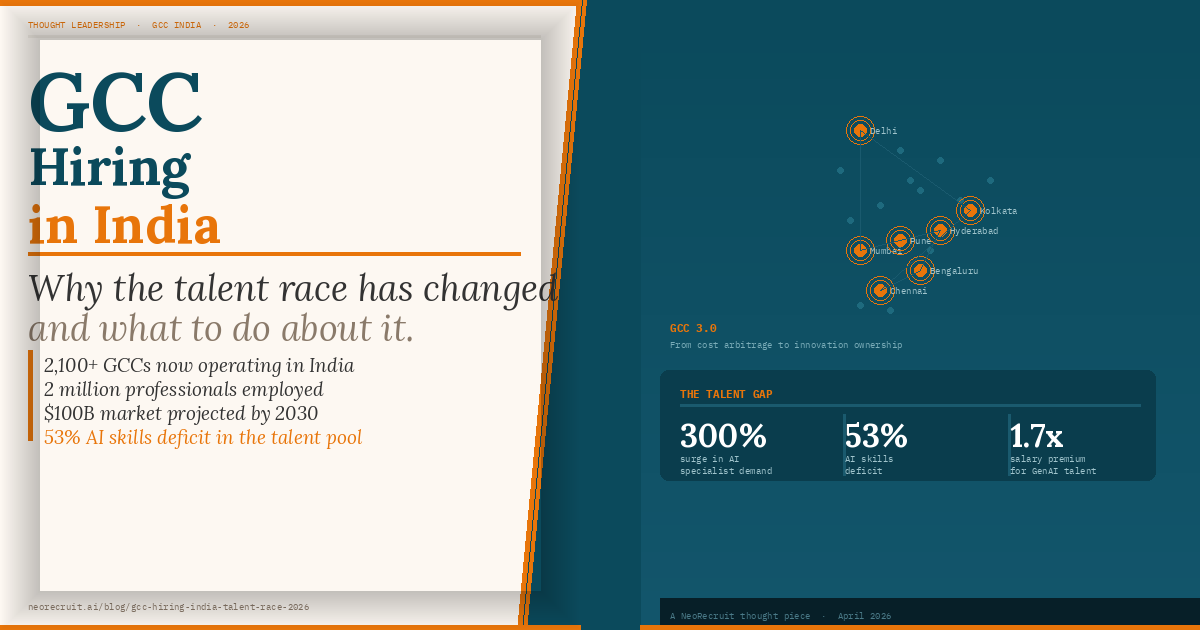
India now hosts over 2,100 GCCs employing close to 2 million professionals, according to NASSCOM and Zinnov data. The sector generates more than $64 billion in annual revenue and is projected to cross $100 billion by 2030. GCCs account for roughly 38% of all office leasing across India's top seven cities. These are not back offices. They are, in a growing number of cases, the actual R&D, product, AI, and risk functions of some of the world's largest enterprises.
Goldman Sachs's India GCC leads quantitative research for global trading desks. Walmart's India center drives the AI infrastructure for one of the world's largest retail operations. Apple, Google, Microsoft, and Amazon all operate major engineering and AI functions from Indian GCCs that report directly to global product leadership, not to an outsourcing vendor.
The transformation is real. But it has created a talent problem that most GCC hiring teams are still trying to solve with the old playbook.
The Problem Is No Longer Volume. It Is Depth.
The original GCC talent challenge was scale. You needed a lot of people, quickly, at a consistent quality level. India's engineering universities produced hundreds of thousands of graduates annually and the pipeline was reliable.
That challenge has not disappeared. India's GCCs are expected to add 425,000 to 450,000 new jobs in 2026 alone, with one million additional roles projected by 2030. The volume requirement is larger than ever.
But the composition of what is needed has shifted dramatically. And that shift is where the real difficulty sits.
Demand for AI specialists in India has surged by over 300% since 2024, yet the country faces an AI skills deficit of nearly 53%. The INTECH Group GenAI engineers command salary premiums of 30 to 60% over adjacent engineering talent. The eight to fifteen year experience cohort — the mid-career professionals who can lead teams, architect systems, and make independent technical judgments — is the hardest segment to hire across AI, cloud, and platform roles.
Around 51% of GCCs in India cite talent retention as their biggest challenge amid growing demand for specialized skills. eSparkBiz That figure is not about junior developers. It is about the specialised talent that GCCs increasingly need to fulfil global mandates.
The skills gap is structural. India's universities are producing graduates at scale, but the curriculum and the experience pipeline have not caught up to what GCC 3.0 actually requires. A GCC hiring for LLM engineering, MLOps, agentic AI product management, or cybersecurity architecture is not drawing from a large and accessible pool. It is competing in one of the tightest talent markets in the world, against other GCCs, against Indian product startups, and against global tech companies with Indian offices — all pursuing the same cohort simultaneously.
What GCC 3.0 Actually Demands from Hiring
The shift from GCC 1.0 (cost arbitrage) to GCC 2.0 (capability centre) to what is now being called GCC 3.0 (innovation and ownership) has fundamentally changed what a hire means.
In the cost arbitrage era, a hire was primarily assessed on technical competency and cost. Could they do the job? Did they fit the budget? Those two questions were usually sufficient.
In the ownership era, a hire is a decision with global consequences. GCCs now hold shared accountability for global decisions. PERSOLKELLY The AI engineer hired in Hyderabad is not supporting a global product. They are building it. The risk professional hired in Chennai is not reviewing decisions made elsewhere. They are making them.
This changes what assessment actually needs to measure. Technical skills are necessary but not sufficient. The ability to reason under ambiguity, communicate across time zones and cultures, take ownership without escalation, and demonstrate judgment in novel situations — these are the capabilities that separate a GCC 3.0 hire from a GCC 1.0 hire.
Traditional screening processes were not designed to measure any of these things. A keyword-matched CV filter tells you what a candidate has done. An adaptive interview that follows up based on their specific answers tells you how they think.
The distinction matters more in GCC hiring than almost anywhere else, because the cost of a wrong hire is not just the salary. It is the global mandate that was misplaced.
The Integrity Problem Nobody Talks About
There is a dimension of GCC hiring that is discussed privately in HR circles but rarely written about directly: the integrity gap between the candidate who interviews and the employee who shows up.
This problem is not unique to India. It is a global phenomenon. But it is acute in GCC hiring for a specific reason: the candidate pool is large, the competition for roles is intense, and the financial incentive to misrepresent capability is significant. A role that pays 60% more than the candidate's current position for skills they partially have is a strong incentive to overstate during the interview.
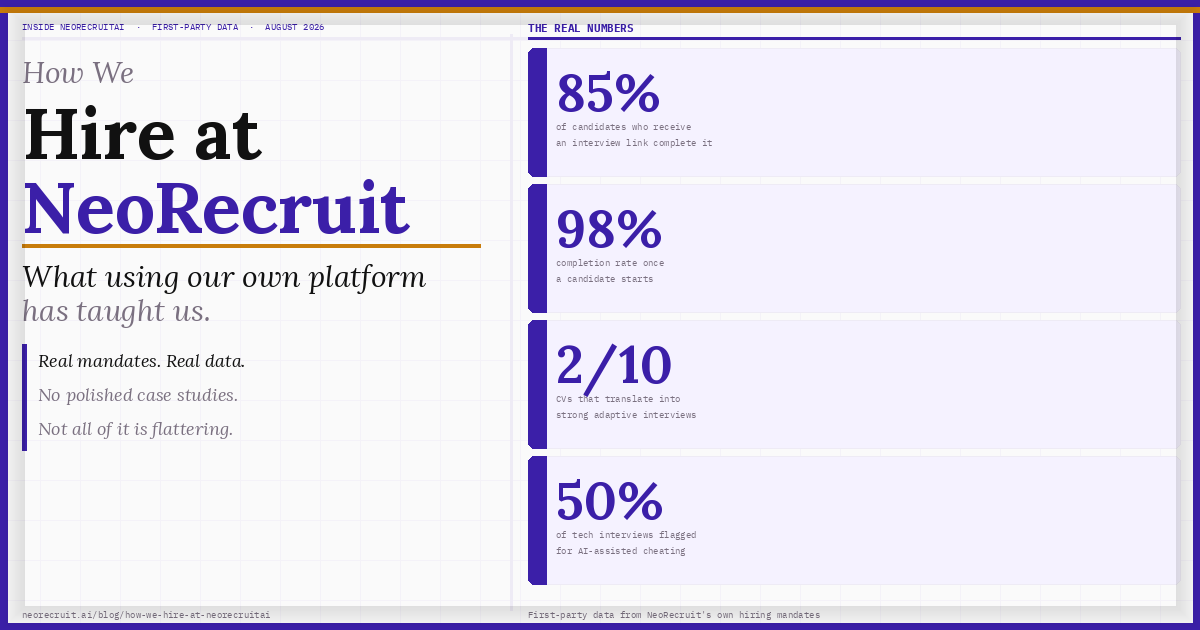
In 2026, that overstatement is increasingly assisted by AI tools. CodeSignal data from February 2026 found that cheating on technical assessments had doubled in just one year, from 16% to 35%. Ptechpartners These are not candidates using a second browser tab to Google an answer. These are candidates running real-time AI copilot tools that generate polished, contextually appropriate responses to interview questions as they are being asked.
For financial services GCCs in particular, the stakes extend beyond hire quality. A candidate who misrepresented their risk management expertise and is now working on AML compliance systems is not just a performance problem. They are an operational risk. This is precisely why regulatory compliance in hiring is not a checkbox exercise. It is a governance matter.
The hiring process that a GCC uses does not just determine who joins the organisation. It determines what the organisation is actually capable of — and whether global headquarters can trust that what they built in India is what they think they built.
The Tier-2 Opportunity and Its Hidden Complexity
Bengaluru still holds around 35 to 39% of all GCC activity in India, with nearly 900 operational units. The INTECH Group But saturation is driving a strategic expansion. Tier-2 cities now host 14% of emerging GCCs and are growing 20% faster than metros. Savannahr Coimbatore, Kochi, Ahmedabad, Trivandrum, Indore, and Nagpur are all seeing GCC investment that was unthinkable five years ago.
The attraction is real. Tier-2 cities offer at least 20% higher talent retention and 40 to 60% operational cost optimisation PERSOLKELLY compared to Bengaluru or Hyderabad, along with direct access to regional engineering talent that metros are struggling to retain.
But Tier-2 hiring introduces complexity that the standard GCC playbook does not handle well.
Employer branding is weaker in Tier-2 markets. A global bank's GCC in Mumbai carries instant credibility. The same bank's GCC in Ahmedabad needs to actively build awareness with the local talent pool. Candidate experience in the hiring process becomes a significant part of that brand-building. How a GCC treats candidates during screening - the clarity of communication, the speed of feedback, the professionalism of the process - is visible in a smaller market in a way it simply is not in Bengaluru, where candidate volumes are high and individual experiences rarely surface.
The speed imperative is also more acute. In a Tier-2 market, a qualified candidate at the offer stage is simultaneously receiving offers from two or three other GCCs. The GCC that screens fastest, communicates most clearly, and runs the fewest friction points in the process wins the hire. The one running a four-week manual screening cycle does not. In a metro, you can sometimes recover a lost candidate through brand pull alone. In Tier-2, you rarely get a second chance.
What the Most Effective GCC Hiring Teams Are Doing Differently
The GCCs that are winning the talent race in 2026 have made three structural changes to how they hire.
They have moved from role-based to skills-based screening. Instead of waiting for the perfect candidate with the perfect resume, progressive centres now map capabilities across AI/ML, cloud architecture, cybersecurity, and product engineering, then hire against skill clusters rather than titles. The INTECH Group This opens the addressable talent pool significantly, particularly for roles where the required combination of skills is too new to have an established career path.
They have replaced volume interview rounds with depth-first assessment. Multiple rounds of generic competency interviews, conducted by different hiring managers with different standards, produce inconsistent results and lose candidates to faster competitors. The most effective GCCs have compressed their screening into fewer, higher-signal stages - using AI-powered adaptive interviews that probe reasoning in real time, followed by targeted technical or domain assessments for shortlisted candidates only.
They have made candidate experience a hiring metric, not an afterthought. In a market where the best candidate has three offers within a week of appearing on the market, how a GCC treats candidates during the hiring process is a direct predictor of offer acceptance rate. This means 24/7 interview availability, fast screening turnaround, and communication that is consistent and human. AI-powered interviews that candidates can complete on their own schedule, in their own language, without coordinating with a recruiter's calendar, address all three requirements simultaneously.
The Financial Services GCC Specifically
Financial services GCCs face a hiring challenge that is more complex than technology GCCs for one fundamental reason: regulatory accountability.
A technology GCC that makes a wrong hire in a product engineering role loses sprint velocity. A financial services GCC that makes a wrong hire in a compliance, risk, or AML function creates a potential regulatory exposure. The hire's qualification is not just an HR question. It is a governance question.
This is why financial services GCCs increasingly need their hiring process itself to be auditable. Not just the outcome but the assessment that led to the decision. What was evaluated. How it was measured. Why a specific candidate was selected over others. These are questions that regulators and internal audit functions are increasingly asking, and hiring teams need to be able to answer them.
An AI interview platform that generates auditable, timestamped assessments with explainable scoring for every candidate is not just an efficiency tool for a financial services GCC. It is a compliance tool.
Where NeoRecruit Fits
NeoRecruit was built for the GCC 3.0 hiring environment. Its adaptive conversational AI avatar conducts real interviews that probe reasoning and adapt to each candidate's specific answers - producing the depth of signal that skills-based GCC hiring requires. NeoEye (patent pending) analyses audio, video, behaviour, and response patterns to detect AI-assisted fraud, giving GCC hiring teams verified assessments rather than polished performances.
The platform supports 60+ languages, making it operationally effective across both metro and Tier-2 hiring in India. Role setup takes under 10 minutes, meaning new requisitions can be live the same day they are approved. Auditable scoring rationale for every candidate satisfies the governance requirements of financial services GCCs and the accountability standards that global headquarters increasingly demand from their India operations.
Clients using NeoRecruit report 90% time saved in pre-screening and 5x more candidates evaluated per hiring cycle - metrics that matter particularly in a market where speed of assessment is a competitive advantage.
The strategic partnership with LexFins 360 extends this further, combining NeoRecruit's AI interview infrastructure with the regulatory and compliance expertise that financial services and fintech GCCs require from initial hire through to onboarding governance.
For GCC leaders who want to explore how this works in practice, a free pilot is available at neorecruit.ai.
The Bottom Line
India's GCC sector is undergoing its most significant structural shift since the first wave of captive centres arrived in the early 2000s. The transformation from cost centre to innovation hub is real, documented, and accelerating.
But the hiring approach that built the first generation of GCCs will not build the next one. Volume screening, generic competency interviews, and manual assessment processes are not designed for a market where AI skills command 60% salary premiums, where 51% of GCCs cannot retain the specialist talent they need, and where the integrity of every hire carries consequences that extend to global headquarters.
The GCCs that will lead the next decade of India's capability economy are the ones that treat hiring as a strategic function, not a transactional one. That means better signal from assessment. It means faster screening without sacrificing depth. It means governance that global headquarters can trust.
The talent is in India. The question is whether your hiring process is sophisticated enough to find it.
Related reading:
TABLE OF CONTENTS
Smarter Hiring Starts Here
Get all four pillars working for you. Automate the busywork, elevate your hires.