
How Banks Are Using AI to Hire Faster Without Compromising Compliance
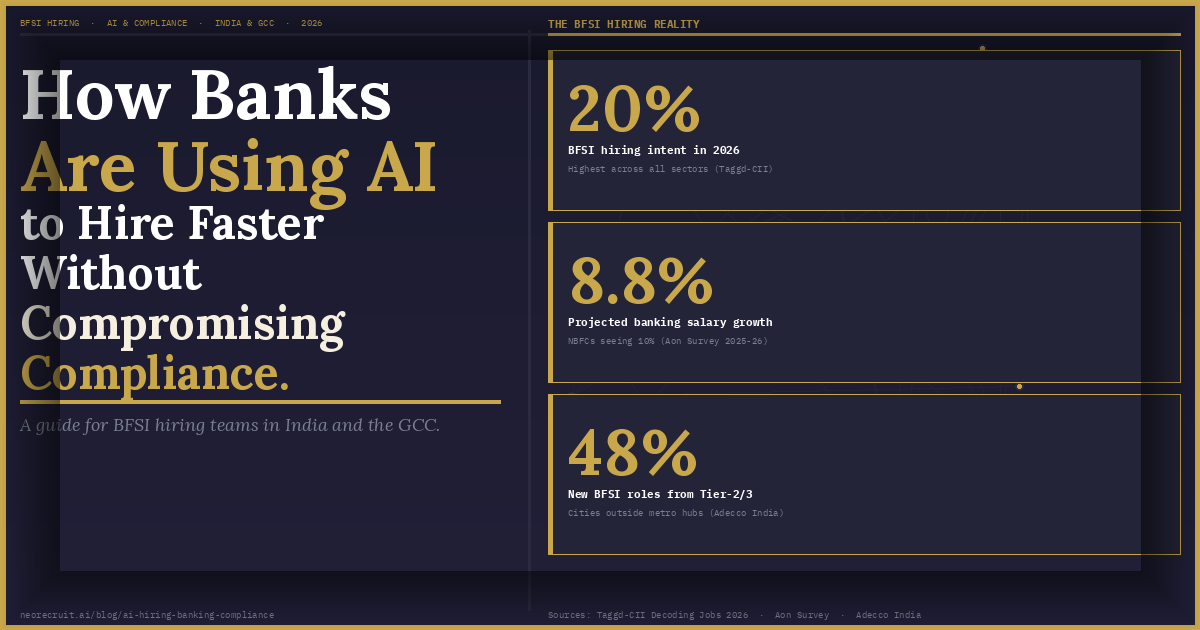
BFSI hiring intent hit 20% in 2026, the highest across all sectors. But banking recruitment has unique compliance requirements that most AI hiring tools were not built for. Here is what works.
Banking and financial services is the most compliance-intensive hiring environment in the world. Every hire in a regulated function carries the weight of the institution's regulatory standing. A wrong hire in a KYC role is not a performance problem. It is an audit finding. A cybersecurity analyst who misrepresented their threat hunting experience is not just underqualified. They are an operational risk.
And yet, according to the Taggd-CII India Decoding Jobs 2026 Report, BFSI hiring intent hit 20% for 2026, the highest across all sectors in India. The sector that needs the most rigorous hiring process is also the one hiring the fastest. The tension between speed and compliance is not new in banking. But in 2026 it has become acute in ways that deserve a clear-eyed look.
What Is Driving the Hiring Surge
The BFSI hiring surge is structural, not cyclical. Three forces are driving it simultaneously and none of them are going away.
Digital transformation pressure. According to research from Taggd, a significant proportion of BFSI institutions report that their workforce does not have the skills to deliver on their digital transformation priorities. The gap between where banks want to go and what their current teams can execute is the primary driver of specialist hiring. AI engineers, cloud platform specialists, payment architecture experts, and regulatory technology professionals are all on active hire across banking globally. A 2024 IBM Institute for Business Value study of banking and financial markets CEOs found that getting the right skills remains a persistent challenge, with CEOs now hiring for roles that did not exist until recently.
GCC expansion in India. According to Taggd's BFSI hiring analysis, over 50 banking GCCs operate more than 90 centres across India, employing over 180,000 professionals. Although BFSI accounts for only 10% of GCCs by volume, it employs 33% of the total GCC workforce in India, signalling a sharp tilt toward capability-led hiring. Global banks are not just expanding in India. They are building their actual risk, compliance, and digital functions there.
Regulatory tightening. The enforcement of India's Digital Personal Data Protection Act in 2025 pushed data governance and privacy-by-design to the forefront, intensifying demand for talent that blends technology, compliance, and data security. Similar pressures are at play across the GCC, where the UAE's PDPL and Saudi Arabia's PDPL both impose requirements on financial institutions that require new categories of compliance-aware technical talent.
The Specific Talent Problem in BFSI
The challenge is not just finding people. It is finding people who carry both dimensions of the requirement.
According to People Matters, a role in fraud detection now combines data science, regulatory understanding, and real-time analytics. A payments specialist is expected to understand cloud infrastructure, cybersecurity, and user experience. Even compliance functions are increasingly intertwined with AI-led monitoring and identity systems.
This is the hybrid-skill problem. The candidate pool for roles that require deep technical ability alongside regulatory literacy is thin everywhere and thinning further as the roles multiply faster than the experience base can grow.
Multiple industry reports point to a significant and widening AI skills gap in BFSI GCCs, with demand for hybrid-skilled talent outpacing supply considerably in 2026.
Salary is not the solution either. According to Aon's Annual Salary Increase and Turnover Survey 2025-26, banking salaries in India are projected to grow 8.8% in 2026, with NBFCs seeing approximately 10% growth. Banks are paying more. The talent they need is still scarce.
The Compliance Problem That AI Hiring Tools Were Not Built For
Most AI hiring tools were designed for the general enterprise market. They optimise for screening speed, candidate volume, and funnel conversion. These are legitimate priorities. They are not the primary priorities for a BFSI hiring team filling a model risk management role or a senior AML analyst position.
BFSI hiring has specific requirements that general AI hiring tools do not naturally address.
Assessment integrity is a regulatory matter, not just an HR one. According to Taggd's BFSI Hiring Trends 2026 report, identity discrepancy rates in BFSI hiring stand at 11.69%, with employment falsification forming nearly 29% of verification issues. When a candidate misrepresents their credentials in a compliance role, the institution's regulatory standing is at risk. The hiring process itself must be auditable.
Automated hiring decisions must be explainable. The UK's Data (Use and Access) Act 2025, the EU AI Act, and the UAE's PDPL all require that automated decisions affecting candidates be explainable and subject to human override. For BFSI institutions operating across multiple jurisdictions simultaneously, this is not an abstract compliance requirement. It is an operational constraint that every AI hiring tool in the stack must satisfy.
The bias lawsuits are a BFSI-specific concern. As we covered in Two Major AI Hiring Platforms Are Being Sued for Bias, Workday and Eightfold AI are facing federal litigation over bias in their automated screening tools. For regulated financial institutions, this is not just a vendor risk. It is an employer liability risk. The Equal Credit Opportunity Act, Fair Housing Act, and equivalent legislation across jurisdictions create specific exposure for financial institutions whose hiring tools produce discriminatory outcomes, even if unintentionally.
Candidate fraud is materially more consequential in finance. A candidate who used AI assistance to pass a technical interview for a software engineering role at a technology company creates a performance problem. A candidate who used the same tools to pass an interview for a credit risk analyst role at a bank, and who is now making decisions about loan portfolios using models they do not understand, creates a risk management problem with regulatory implications.
What Effective AI Hiring Looks Like in BFSI
The banks and financial services institutions navigating this well in 2026 have made a clear distinction between the parts of the hiring process where AI adds speed without compromising rigour, and the parts where the integrity of the assessment is the entire point.
Where AI adds value without compliance risk:
CV screening that evaluates context rather than keywords. A BFSI CV parser that understands the difference between a candidate who processed KYC verification and one who architected the KYC system is more useful than a keyword filter that treats both the same. ATS automation that moves candidates through scheduling, documentation, and coordination stages without recruiter involvement. Job description optimisation that removes language patterns that historically produce non-diverse shortlists.
Where AI assessment integrity is the deciding factor:
The interview stage is where BFSI hiring teams need the most rigour and, historically, have had the least standardisation. Different hiring managers, different questions, no audit trail, no consistent scoring rubric, and in 2026 an increasing risk that the candidate is using AI assistance to generate impressive-sounding answers to questions they cannot actually answer from experience.
NeoRecruit addresses this specific gap. The adaptive conversational AI avatar generates each follow-up question from what the candidate said in their previous answer. For a BFSI role, this means a candidate who claims experience in model risk validation gets follow-up questions about the specific validation frameworks they used, the assumptions they challenged, and the regulatory interactions that resulted. These questions cannot be pre-loaded into an AI copilot because they depend on what the candidate said first.
NeoEye (patent pending) sits on top of this as a second layer, analysing audio, video, behaviour, and response patterns simultaneously to generate a timestamped, auditable risk score for every flagged session. Every session produces structured evidence that satisfies the explainability requirements of the UK DUAA, EU AI Act, and regional compliance frameworks.
For financial services GCCs specifically, the combination of adaptive interview design and multimodal fraud detection produces assessments that are both more accurate and more defensible than standard video interview or text chat approaches.
In partnership with LexFins 360, NeoRecruit offers BFSI organisations a comprehensive hiring and advisory pathway, combining AI-led sourcing and adaptive interviews from NeoRecruit with the financial, legal, and compliance expertise of LexFins 360 across corporate governance, regulatory requirements, and market entry for firms operating in India and internationally.
The Tier-2 Dimension
According to Adecco India data cited by Taggd, nearly 48% of new BFSI roles are originating from Tier-2 and Tier-3 cities. This is a significant shift from the traditional concentration of financial services hiring in Mumbai, Delhi, and Bengaluru.
The Tier-2 expansion creates specific hiring challenges for BFSI institutions. Employer brand recognition is lower. The candidate pipeline is less uniform in background and experience. Screening processes that work in metro markets need to function equally well in Coimbatore, Lucknow, or Ahmedabad.
An AI interview platform that operates 24/7, requires no scheduling coordination, and delivers consistent assessment regardless of location is structurally well-suited to Tier-2 hiring. The candidate completes the interview on their schedule without travel to a branch or assessment centre. The hiring team reviews structured, comparable evaluations rather than relying on the memory and interpretation of a local branch manager.
A Practical Framework for BFSI Hiring Teams
Based on the data and the compliance requirements specific to financial services, here is a practical stack for BFSI hiring teams in 2026.
Sourcing: Naukri for volume inbound across India, LinkedIn for mid-senior and specialist passive candidates, Taggd for AI-matched BFSI-specific talent pipelines.
ATS: Darwinbox or Zoho Recruit as the system of record, with full documentation of every stage of the hiring process.
Assessment: Skills-based pre-screening for technical roles using validated assessments from Mercer Mettl, focused on the specific technical domains relevant to the role.
Interviews: NeoRecruit's adaptive AI avatar for structured, fraud-resistant, auditable assessment at scale. Produces explainable scoring rationale that satisfies regulatory requirements across the UK, EU, India, and GCC.
Background verification: Initiated before the offer stage, not after. Given employment falsification rates in BFSI hiring, verifying credentials before the offer reduces both rescinded offers and the downstream compliance risk of an unverified hire reaching a sensitive role.
Compliance advisory: LexFins 360 for organisations that need financial, legal, and compliance advisory support alongside their hiring process, covering corporate structuring, regulatory compliance, and governance requirements for firms operating in India and internationally.
The Bottom Line
BFSI is the highest-growth, highest-compliance hiring environment of 2026. The tools available to speed up hiring are more powerful than they have ever been. The regulatory requirements governing how that hiring must be documented, explained, and defended are more demanding than they have ever been.
The institutions that will navigate this well are not those that chose speed over compliance or compliance over speed. They are those that chose hiring technology that delivers both, because it was designed with both requirements in mind from the beginning.
Book a free pilot at neorecruit.ai
Related reading:
TABLE OF CONTENTS
Smarter Hiring Starts Here
Get all four pillars working for you. Automate the busywork, elevate your hires.