
AI Recruitment Platforms in India: How Enterprises Are Building Their Hiring Stack in 2026
How Indian enterprises and GCCs are building their AI recruitment stack in 2026 — what works at each stage of the funnel, what does not, and where most hiring teams are leaving value on the table.
Most conversations about AI recruitment platforms in India start with a list of tools and end with a recommendation to book a demo. This is not that article.
Enterprise hiring teams in India in 2026 are not short of tools. They are short of clarity on how to combine them. The average enterprise HR tech stack in India now includes an HRMS, an ATS or recruitment module, one or more job board subscriptions, a video interview or assessment tool, and sometimes a separate sourcing platform. Each of these was purchased to solve a specific problem. In practice, they often create new ones - data that does not flow between systems, candidate records that have to be re-entered three times, assessment scores that live in a spreadsheet disconnected from the ATS, and hiring managers who have stopped trusting the process because the signal quality is too low.
This article is about how Indian enterprises, particularly those with 500 to 5,000 employees across BFSI, technology, ITES, and GCCs, are building their hiring stacks in 2026. What the most effective stacks look like. Where most teams are under-investing. And what the arrival of AI interviewing as a distinct category means for how the rest of the stack gets used.
The Three Generations of Enterprise Hiring Tech in India
Understanding where enterprise hiring tech is today requires a brief look at how it evolved.
Generation 1 - Process Digitisation (2005 to 2015)
The first wave was about replacing paper. Job posting through Naukri. CV storage in spreadsheets or basic HRMS. Email-based interview coordination. The primary win was volume management - receiving and organising hundreds of applications without a paper trail.
Generation 2 - Workflow Automation (2015 to 2022)
The second wave was about automating the workflow. ATS platforms like Zoho Recruit and Darwinbox's recruitment module standardised the pipeline stages. Automated email triggers replaced manual follow-ups. Interview scheduling tools removed some coordination overhead. The primary win was consistency — the same process applied to every candidate regardless of which recruiter was managing the role.
Generation 3 - AI-Driven Signal Quality (2022 to present)
The current wave is about improving the quality of the signal at each stage rather than just the speed of processing. AI resume screening that evaluates context, not keywords. Job boards that surface candidates based on inferred skills, not just title matching. And most recently, AI interview platforms that conduct adaptive conversations rather than collecting scripted video responses.
Most Indian enterprise HR teams are operating somewhere between Generation 2 and Generation 3. They have the workflow automation. They are in the process of upgrading the signal quality and the gaps in that upgrade are where hiring problems concentrate.
The Five Layers of an Enterprise Hiring Stack
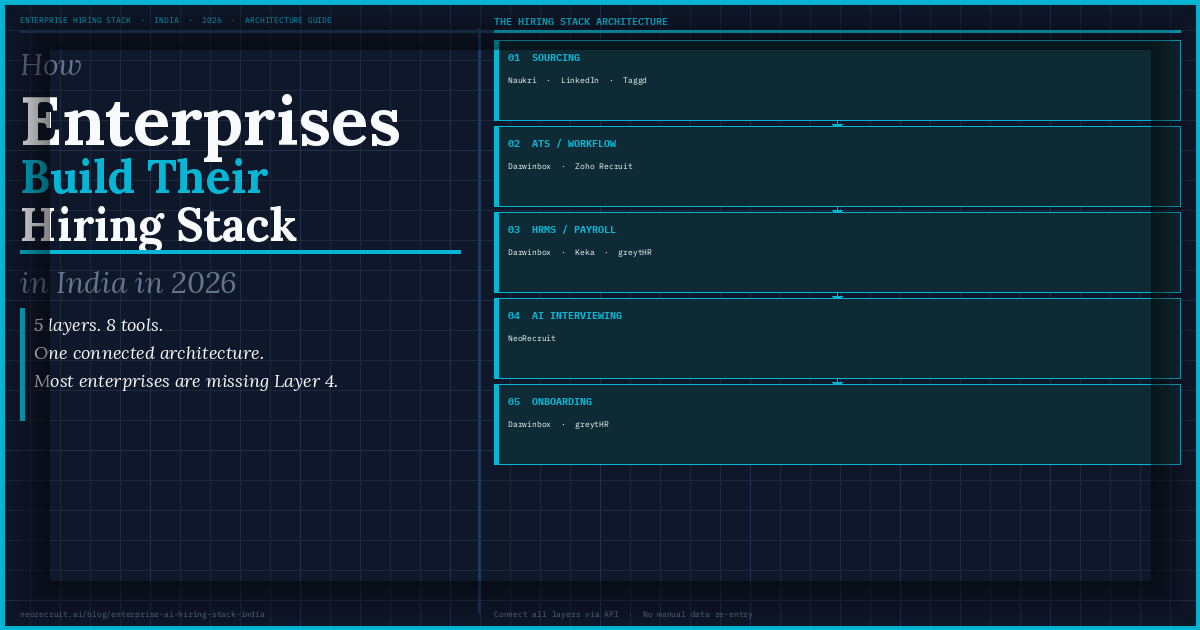
A well-built enterprise hiring stack in India covers five distinct functions. Each requires a different type of tool. The most common mistake is expecting one tool to do all five adequately.
Layer 1: Sourcing
What it does: Finds candidates who match the role - both those who have actively applied and those who have not.
The India-specific reality: Naukri.com with 90 million+ registered candidates is non-negotiable for inbound volume. LinkedIn Talent Solutions is the primary channel for mid-senior and specialist hiring. For GCCs and enterprises hiring AI, cloud, and cybersecurity specialists, platforms like Taggd add AI-driven matching from a curated database on top of raw job board volume.
Hiring by GCCs rose 13% month on month in January 2026 and was 7% higher than a year earlier, even as overall tech demand remained flat to weak. BW Businessworld The divergence between GCC hiring growth and general tech hiring slowdown means competition for the same specialist candidates is intensifying, and quality sourcing is increasingly a competitive advantage.
Where most enterprise teams underinvest: Senior and specialist roles above eight years of experience. Naukri's database skews toward active job seekers. The most qualified candidates at this level are often not actively looking - they need to be found through LinkedIn or specialist platforms, not waited for.
Layer 2: Applicant Tracking
What it does: Manages inbound applications, moves candidates through pipeline stages, coordinates interviews, and maintains the record of every hiring decision.
The India-specific reality: For enterprises of 500+ employees, Darwinbox is the dominant choice because it combines ATS functionality with full HRMS - payroll, attendance, and performance management - eliminating the data handoff problem. For companies already in the Zoho ecosystem, Zoho Recruit is a strong standalone ATS. Keka serves the mid-market well with strong Indian statutory compliance.
The ATS is the system of record. Everything else in the stack should connect to it. A well-configured ATS is the infrastructure that makes the rest of the stack measurable.
Where most enterprise teams underinvest: Integration between the ATS and the assessment and interview layers. Most enterprises have ATS data and interview data living in separate systems with no automatic sync. Hiring decisions get made based on whoever wrote the most recent email, not on structured, comparable assessment data across candidates.
Layer 3: Assessment
What it does: Validates that candidates have the specific skills required for the role before they advance to live interviews.
The India-specific reality: Skills-based assessment has become essential in India because the hottest skills across Indian GCCs in 2026 include AI/ML engineering, MLOps, cloud platform engineering, cybersecurity, data engineering, and product management The INTECH Group - roles where a CV says very little about actual capability. TestGorilla, Mercer Mettl, and iMocha are widely used for cognitive and technical assessments in the Indian enterprise market.
The problem with assessment-only platforms is that they measure what a candidate can do in a controlled, timed environment - which is increasingly gameable. CodeSignal data from February 2026 found that cheating on technical assessments doubled in a single year, from 16% to 35%. Ptechpartners A candidate who passes a skills test with AI assistance and moves to an interview round is still a wrong hire waiting to happen.
Where most enterprise teams underinvest: Assessment of reasoning and judgment, not just technical skills. The roles that drive the most value in a GCC or enterprise - AI product management, risk governance, strategic analytics - require judgment that no skills test can measure. This is where the interview layer becomes critical.
Layer 4: Interviewing
What it does: Evaluates whether the candidate can actually do the job - their reasoning, communication, judgment, and genuine capability - in a way that is consistent, fraud-resistant, and auditable.
The India-specific reality: This is the most under-invested layer in the Indian enterprise hiring stack. Most enterprises rely on unstructured human interviews - different hiring managers asking different questions with no standardised scoring, no audit trail, and no fraud detection. The cost of this inconsistency shows up in two ways: variable hiring quality across teams and candidates who performed well in interviews but not in the role.
In 2026 this problem is significantly worse than it was three years ago. Candidates now routinely use AI copilot tools during interviews to generate polished, contextually appropriate answers in real time. The gap between interview performance and actual job performance is widening as a result.
NeoRecruit was built specifically to solve this problem at the interview stage. Its adaptive conversational AI avatar conducts real interviews - generating follow-up questions based on what each candidate actually said in their previous answer, probing reasoning in real time the way a skilled interviewer would. Because the follow-up is dynamically generated from the specific previous answer, candidates cannot pre-load AI-generated responses. The conversation adapts in real time to what was said.
NeoEye (patent pending) sits on top of this as a second layer - analysing audio, video, behaviour, and response patterns simultaneously to detect AI-assisted fraud and generate a timestamped, auditable risk score for every flagged session.
The result is a verified assessment - not a polished performance - delivered at scale, 24/7, across multiple roles simultaneously. Hiring teams review structured, comparable evaluations for every candidate rather than relying on the recall and interpretation of each interviewer.
Clients using NeoRecruit report 90% time saved in pre-screening and 5x more candidates evaluated per hiring cycle. The platform supports 60+ languages and integrates with major ATS platforms via API, sitting between the sourcing and assessment layers and the final hiring decision without replacing any existing infrastructure.
Where most enterprise teams underinvest: Standardisation and auditability. Most enterprises cannot produce a structured record of why a specific candidate was hired over another. For financial services GCCs and regulated industries this is a governance risk. For any enterprise managing a large hiring function it is a quality risk.
Layer 5: HRMS and Onboarding
What it does: Manages the transition from candidate to employee - offer management, background verification, statutory compliance, payroll setup, and onboarding workflows.
The India-specific reality: Darwinbox and Keka both handle this well for the Indian market with strong PF, ESI, and TDS compliance. greytHR is the strongest choice for payroll-first organisations. The onboarding integration with the ATS is where most enterprises lose data - candidate information collected during recruitment has to be re-entered into payroll systems, creating errors and compliance risk.
Where most enterprise teams underinvest: Background verification integrated into the hiring workflow rather than initiated after the offer is accepted. In a market where candidate fraud is increasing, verifying credentials before the offer stage rather than after reduces both the frequency of rescinded offers and the reputational damage they cause.
What the Most Effective Enterprise Stacks Look Like
After mapping the five layers, the most effective enterprise hiring stacks in India in 2026 follow a consistent pattern.
They use best-in-class tools per layer rather than one all-in-one platform. No single platform does all five layers equally well. Darwinbox is the strongest HRMS. Naukri is the strongest sourcing volume channel. NeoRecruit is the strongest interview layer. Expecting Darwinbox's interview module to match a dedicated AI interview platform, or expecting Naukri to replace a proactive LinkedIn sourcing strategy, produces mediocre results at every stage.
They connect the layers through integrations rather than manual data transfer. Every handoff between layers that requires a human to re-enter data introduces latency, errors, and friction. The best stacks are connected through APIs so candidate data flows automatically from sourcing through assessment through interview through offer through onboarding without manual intervention.
They measure signal quality at each stage, not just volume. Filling a role is not the same as making a good hire. The metrics that matter are offer acceptance rate, time-to-productivity, and six-month retention - not time-to-offer or number of CVs screened. These downstream metrics only improve when the signal quality at each stage - sourcing relevance, assessment accuracy, interview integrity improves.
A Practical Stack for Indian Enterprises in 2026
The One Investment Most Enterprises Are Not Making
The pattern across the most common enterprise hiring stack failures in India is consistent: significant investment in sourcing, reasonable investment in ATS and HRMS, almost no investment in the interview layer beyond ad hoc human interviews with no standardisation.
The interview stage is where the most consequential hiring decisions are made and where the least technology is applied. It is also where the integrity problem is most acute — candidates who have cleared your ATS screening, passed your skills assessment, and been shortlisted by your sourcing team can still be AI-assisted performers who will not survive their first sprint.
Fixing this does not require replacing your existing stack. NeoRecruit integrates into what you already have. It sits between your assessment layer and your final hiring decision, adding structured, fraud-resistant evaluation that your current process cannot produce. Book a free pilot at neorecruit.ai.
Related reading:
TABLE OF CONTENTS
Smarter Hiring Starts Here
Get all four pillars working for you. Automate the busywork, elevate your hires.