
Beyond the Org Chart: Why Your Most Productive Employee Doesn't Have a Heartbeat
The future of work belongs to those who can align strategy, intelligent agents, and execution seamlessly
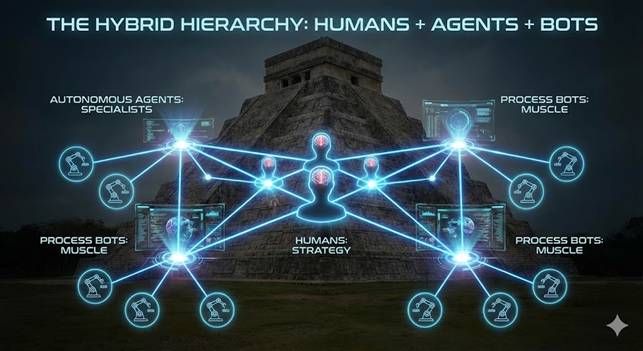
From Org Chart to Neural Network: How Hybrid Hierarchies Are Rewriting Leadership
For over a century, the corporate world has been obsessed with the "Pyramid." It was a simple, comforting structure: the CEO at the top, layers of management in the middle, and a broad base of "doers" at the bottom. It was designed for stability, clear lines of command, and human-only input.
But as we navigate 2026, the pyramid isn't just cracking; it’s being replaced by a Neural Network. The most successful companies are no longer just managing people. They are managing a Hybrid Hierarchy - a three-tiered ecosystem composed of Humans, Autonomous Agents, and Process Bots. If you are still trying to lead your department using a 20th-century org chart, you are effectively trying to fly a drone with a horsewhip.
The New Triad of Productivity
In a hybrid hierarchy, we no longer view AI as a "software subscription" on a line item. Instead, we view it as a functional entity with specific responsibilities.
The Strategic Human (The Architect)
The human sits at the center of the network, not necessarily at the "top." Their role is to provide the intent, ethics, and creative spark. They define the "Why" and the "So What," while delegating the "How" to the rest of the network.
The Autonomous Agent (The Specialist)
These are AI entities capable of independent reasoning and action within a specific domain. They don't just wait for a prompt; they monitor data and act on it. An "Agent" might be responsible for real-time supply chain adjustments or 24/7 social sentiment management.
The Process Bot (The Muscle)
These are the highly efficient, non-reasoning tools that handle high-volume, repetitive data movement. They are the digital plumbing that connects the Human’s strategy to the Agent’s specialized execution.
Illustration 1: The Modern Supply Chain "Squad"
Imagine a global retail brand facing a sudden shipping crisis in the Pacific.
In the old hierarchy, this would trigger a weeks-long chain of human meetings, data requests, and manual spreadsheets. In the 2026 Hybrid Hierarchy, the team functions as a single unit:
- The Agent: A "Logistics Optimizer" agent detects the delay in real-time. It doesn't just flag it; it autonomously scans for alternative routes, negotiates spot-rates with secondary carriers, and presents three viable "battle plans" to the team.
- The Human: The Logistics Manager reviews the three plans. They use their human intuition to realize that while Plan A is cheapest, it uses a carrier currently facing a labor strike - a nuanced piece of "soft data" the AI missed. They authorize Plan B.
- The Bot: Once the human hits "Approve," the Process Bots handle the thousands of tiny administrative tasks: updating invoices, notifying customers, and re-routing warehouse schedules.
Illustration 2: The "Agentic" Creative Agency
In the creative world, the hierarchy has shifted from "Director and Designers" to "Curator and Agents."
- The Human (Curator): Instead of spending weeks on a mood board, the Creative Director defines the "Brand Soul" and the target emotional resonance of a campaign.
- The Agents: A "Visual Agent" generates 500 aesthetic directions; a "Cultural Context Agent" checks them for global sensitivity; a "Predictive Agent" forecasts which visual will convert best with Gen Alpha.
- The Outcome: The human doesn't do the "labor" of creation; they do the higher-order labor of selection and refinement.
The New Leadership Skill: Orchestration
Managing a hybrid team requires a different kind of leader. You are no longer a "taskmaster"; you are an Orchestrator. The biggest challenge in 2026 isn't the technology - it’s the psychological safety of the humans in the network. If your human employees feel they are competing with the agents for their jobs, the network will fail. High-performing leaders are those who can prove to their team that the AI is there to "upscale" their humanity, not replace it.
When hiring for leadership roles in this environment, look for:
- Systems Thinking: Can they visualize how a change in an AI agent's logic will ripple through the human team?
- Conflict Resolution (Human-AI): Can they troubleshoot when a human team member stops trusting the data coming from an autonomous agent?
- Strategic Intent: Can they give clear, unambiguous directions that a machine can execute and a human can get behind?
The "Pyramid" was built for an era where information moved slowly. The "Neural Network" is built foran era where information is instantaneous.
In 2026, your competitive advantage isn't how many people you manage. It’s how effectively you orchestrate the dance between the humans who dream and the agents that do.
TABLE OF CONTENTS
Smarter Hiring Starts Here
Get all four pillars working for you. Automate the busywork, elevate your hires.