
AI Proctoring vs Human Proctoring: Which is Better for Hiring?
AI proctoring vs human proctoring: compare cost, accuracy, scalability, and candidate experience to find the right approach for your hiring process in 2026.
The question used to be simple. You put a person in the room. They watched. Cheating was hard.
Remote hiring changed everything. When candidates interview from their homes, offices, cafes, and bedrooms across four time zones simultaneously, the idea of a human watching every single one becomes operationally impossible. Something had to fill that gap.
That something is AI proctoring. But whether it actually replaces human judgment, supplements it, or falls dangerously short of it depends entirely on what you are trying to protect against. And in 2026, what you are trying to protect against has changed dramatically.
This article gives hiring teams, HR leaders, and talent acquisition heads a complete, honest comparison of AI proctoring and human proctoring across every dimension that matters.
What is Human Proctoring?
Human proctoring means a trained person monitors a candidate's interview or assessment in real time. In a remote context, this happens via webcam, screen share, and audio feed. The proctor watches, interprets, and intervenes when something seems wrong.
The strengths of human proctoring are well established.
Contextual judgment. A human can distinguish between a candidate who is nervous and one who is reading answers off a second screen. They can tell the difference between someone thinking hard and someone waiting for an AI tool to generate a response. They pick up on subtle cues: hesitation patterns, eye movements that suggest reading rather than recalling, responses that are too polished for the question's difficulty.
Real-time intervention. If something looks wrong, a human proctor can act immediately. They can ask the candidate to show their surroundings, repeat a question in a different way, or terminate the session. AI can only flag.
Candidate support. When a candidate has a technical issue, a human can help. When anxiety spikes, a human presence can actually reduce it. When rules need clarifying, a human can explain.
The weaknesses are equally well established.
Scale. You cannot put a human proctor on every interview when you are running hundreds simultaneously. Hiring volume makes human proctoring prohibitively expensive at scale.
Consistency. Human proctors get tired. They have biases. One proctor's threshold for suspicious behaviour is different from another's. The same candidate behaviour might get flagged by one proctor and ignored by another.
Cost. Human proctoring requires trained staff, scheduling coordination, and time zone coverage. For organisations running high-volume hiring across global markets, the operational cost is significant.
What is AI Proctoring?
AI proctoring uses machine learning algorithms to monitor candidates automatically. It tracks eye movements, facial presence, audio patterns, tab switching, screen activity, and behavioural signals, flagging anything that falls outside normal parameters.
The strengths of AI proctoring are compelling for hiring at scale.
Scalability. AI can monitor thousands of candidates simultaneously with no additional cost per candidate. There are no shift schedules, no time zone complications, no availability constraints.
Consistency. AI applies the same rules to every candidate. There is no fatigue, no bias in who gets more scrutiny, no variation in standards across a large hiring cohort.
Cost efficiency. After initial setup, the per-candidate cost of AI proctoring drops significantly compared to human proctoring at equivalent scale.
Speed. AI generates timestamped evidence reports immediately after each session. Human review of flagged sessions can happen asynchronously, at the hiring team's convenience.
24/7 availability. Candidates can interview at midnight on a Sunday and the monitoring is identical to a Tuesday morning session.
The weaknesses are equally important to understand.
False positives. AI proctoring systems regularly flag innocent behaviour. A candidate who talks to themselves while thinking, glances away when recalling information, or sits in a room with variable lighting can trigger alerts that waste reviewer time and create unfair impressions of honest candidates.
Limited contextual understanding. AI struggles with nuance. It sees a pattern and matches it to a rule. It cannot tell the difference between a candidate reading from an invisible AI overlay and one with an eye condition that affects gaze tracking.
The 2026 problem. This is the critical one. The most sophisticated cheating tools of 2026, including Cluely, Interview Coder, and Parakeet AI, are specifically engineered to be invisible to standard AI proctoring. They operate at the graphics layer beneath what screen sharing captures. They use hands-free audio assistance that leaves no digital trail. Traditional AI proctoring, which was built to catch tab switching and second faces on camera, cannot detect them.
The 2026 Cheating Landscape Changes the Equation
This is where the standard AI vs human proctoring comparison breaks down. Neither traditional AI proctoring nor standard human proctoring is well-equipped to catch what candidates are actually using in 2026.
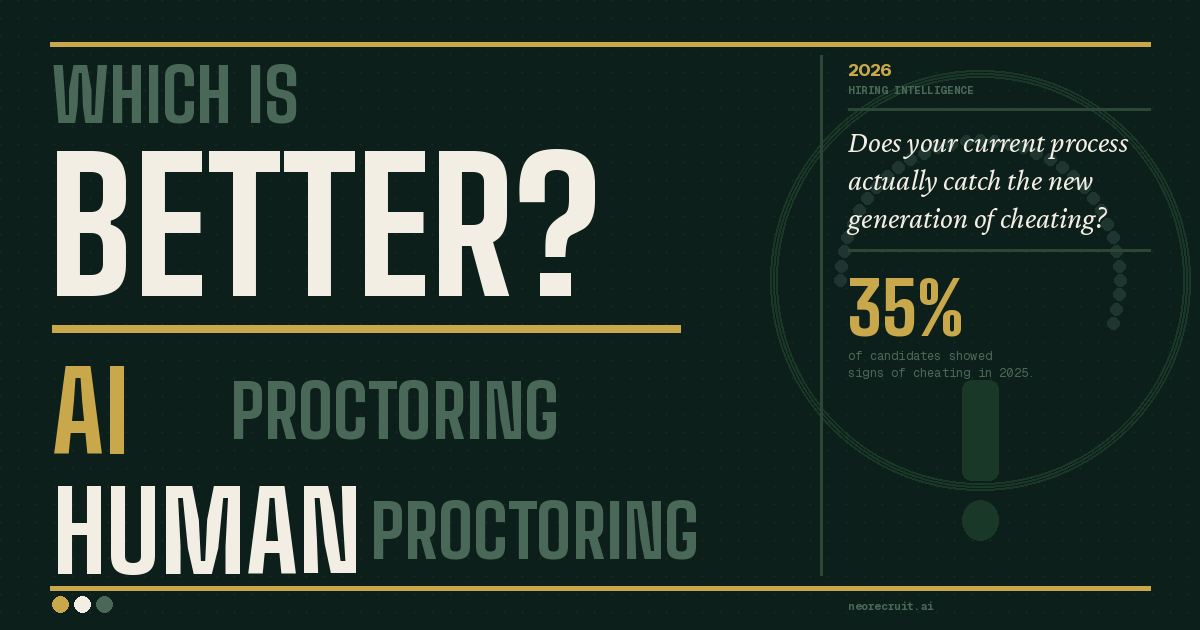
35% of candidates showed signs of cheating in late 2025, more than double the rate from six months earlier. Tools like Cluely and Interview Coder use invisible screen overlays that are undetectable by standard screen sharing. Traditional proctoring methods including tab-switching detection and browser lockouts have been rendered obsolete.
A human proctor watching a webcam feed cannot see a transparent overlay on the candidate's screen. They cannot hear a voice assistant whispering answers through an earpiece. They can spot a candidate whose eyes move horizontally in a reading pattern rather than the upward drift of genuine recall, but only if they know what to look for and are watching closely enough.
Standard AI proctoring cannot detect any of these tools because they are designed to evade exactly the signals AI monitors for.
The question in 2026 is not simply "AI or human?" It is "which approach is built for the threats that actually exist right now?"
Head-to-Head Comparison
ScalabilityAI wins decisively. Human proctoring cannot scale to hundreds of simultaneous interviews without enormous cost. AI monitors every candidate equally regardless of volume.
Contextual judgmentHuman wins. A trained human proctor interprets nuanced behaviour that AI misses. They distinguish nervousness from deception, thinking from reading, genuine hesitation from waiting for an AI prompt.
ConsistencyAI wins. Human proctors vary in attention, threshold, and bias. AI applies identical standards to every candidate in every session.
Cost at scaleAI wins. Human proctoring becomes exponentially expensive as volume grows. AI cost is largely fixed after setup.
Candidate experienceThis depends on implementation. Human proctoring can feel invasive and anxiety-inducing. AI proctoring can feel cold and impersonal. Well-designed AI that gives candidates clear instructions and treats flagging as a review rather than an accusation scores better on candidate experience than a judgmental human proctor, but worse than no proctoring at all.
Detection of 2026 AI cheating toolsNeither standard approach wins. This is the gap that purpose-built multimodal detection systems like NeoEye are designed to fill.
Real-time interventionHuman wins. AI flags. Humans act.
Privacy and complianceThis depends on implementation. Both approaches collect sensitive data. GDPR, India's DPDP Act, and similar frameworks apply to both. AI proctoring that stores biometric data carries additional compliance risk if not architected carefully.
The Hybrid Model: Where Most Organisations Are Heading
In 2026, many institutions prefer a hybrid model where AI handles monitoring while humans review flagged sessions. This is the pragmatic answer to the either/or question.
In a well-designed hybrid model:
- AI monitors every candidate continuously, tracking behavioural signals, audio patterns, screen activity, and environmental cues
- Flagged sessions are queued for human review rather than automatic penalisation
- Human reviewers apply judgment to ambiguous cases, distinguishing genuine violations from false positives
- Only confirmed violations result in action
This approach gives you AI's scale and consistency combined with human judgment at the decision point where it matters most.
The practical challenge is that "hybrid" is often used loosely. Some platforms call themselves hybrid when they simply record sessions and have a human spot-check a sample afterwards. That is not a hybrid model. It is delayed human review on a fraction of cases.
A genuine hybrid model has AI and human judgment integrated at the right stages of the process, with clear escalation paths and consistent standards for what triggers human review.
A Third Approach: Integrity by Design
The most forward-thinking hiring platforms in 2026 are moving beyond the monitor-and-flag model entirely.
The insight driving this shift: if the interview itself is adaptive and conversational, AI cheating tools cannot keep up. A candidate cannot prompt ChatGPT fast enough to generate a contextually accurate response to an adaptive follow-up question about their specific previous answer. The interview design becomes the first layer of integrity.
NeoRecruit's approach combines this conversational integrity layer with NeoEye, a patent-pending multimodal anti-cheat detection system (US Provisional Patent 63/920,469) that analyses audio, video, behaviour, and response patterns simultaneously. Rather than simply monitoring for known signals of cheating, it detects the behavioural signatures of using AI tools even when those tools are technically invisible to screen sharing software.
This is not AI proctoring in the traditional sense. It is a fundamentally different architecture, one built specifically for the 2026 threat landscape rather than retrofitted from academic exam monitoring.
Which Should You Choose?
Choose human proctoring if:
- You are running high-stakes assessments for a small number of candidates where the cost of a fraudulent hire is extremely high, such as executive roles, security-cleared positions, or medical licensing
- You need real-time intervention capability
- Your candidates require accessibility support during the assessment
- Legal or regulatory requirements in your sector demand human oversight
Choose AI proctoring if:
- You are running high-volume screening across hundreds or thousands of candidates simultaneously
- Budget and operational scale make human proctoring impractical
- You need 24/7 global availability without scheduling constraints
- You are screening for early-career or graduate-level roles where the primary risk is basic cheating rather than sophisticated AI-assisted fraud
Choose a hybrid or purpose-built model if:
- You are hiring for technical or specialist roles where AI-assisted cheating is a genuine and growing risk
- You need scale without sacrificing the judgment required for borderline cases
- Your hiring spans multiple regions and time zones simultaneously
- You want timestamped, auditable evidence for every flagged session
The Honest Answer
There is no universally correct answer to "AI proctoring vs human proctoring." The right answer depends on your volume, your budget, your sector, and the specific threats you are trying to defend against.
What is clear in 2026 is that neither approach in its traditional form is sufficient on its own. Neither was built for the AI-assisted cheating tools that are now mainstream. The organisations getting this right are combining the scale of AI with the judgment of humans, and layering purpose-built detection on top for the threats that neither catches alone.
The question worth asking is not "AI or human?" It is "what are candidates actually using to cheat, and does my current approach detect it?"
See How NeoRecruit Handles Interview Integrity
NeoRecruit combines adaptive AI interviews that make cheating structurally difficult with NeoEye's multimodal detection that catches it when attempted. Your team reviews verified evidence, not guesswork.
Book a demo to see NeoRecruit's integrity features in action
TABLE OF CONTENTS
Smarter Hiring Starts Here
Get all four pillars working for you. Automate the busywork, elevate your hires.