
Rise of DQ: The new metric every leader must look for while hiring
In an AI-first world, Digital Quotient (DQ) determines who adapts, leads, and stays relevant.
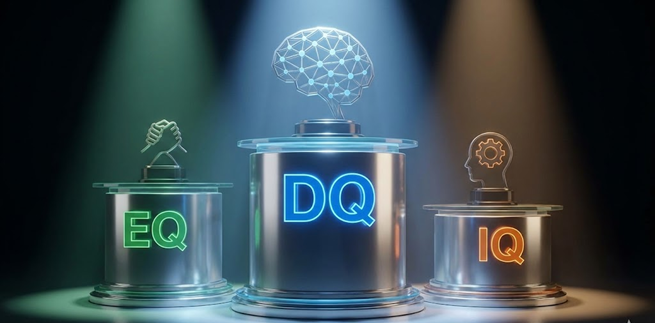
Why IQ and EQ Are No Longer Enough in the Age of AI
For decades, the "gold standard" of talent was built on a two-pillar foundation: IQ (cognitive intelligence) and EQ (emotional intelligence). We looked for people who were smart enough to solve the problem and socially aware enough to lead the team.
But as we navigate 2026, those two pillars are no longer enough to support a modern career. As AI agents move from being simple tools to active "co-workers," a third pillar has emerged as the ultimate predictor of success: DQ, or Digital Quotient.
DQ is not about being a coder or a "techie." It is the ability to orchestrate, audit, and evolve alongside autonomous technology. It is the difference between someone who uses AI to do their old job slightly faster and someone who uses AI to reinvent what their role can achieve.
The Legacy Knowledge Trap
In the past, we hired for Legacy Knowledge - the accumulated facts and experiences gathered over a 20-year career. In a stable world, that experience was a protective moat.
Today, that moat has dried up. When the underlying technology of an industry changes every six months, what you knew yesterday is often less valuable than how fast you can unlearn it today. This is the heart of DQ: Learning Velocity. Imagine a veteran Marketing Director who has spent two decades mastering traditional SEO. If their DQ is low, they will view Generative AI as a threat to be resisted. If their DQ is high, they will immediately pivot to becoming a "System Architect," designing the high-level prompts and ethical guardrails that allow an AI fleet to execute 1,000 hyper-personalized campaigns simultaneously. They didn't lose their marketing skill; they upscaled it through technology.
DQ in Action: Three Modern Illustrations
To understand how to identify high DQ, we must look at how it manifests in the daily life of a professional through these three lenses.
Algorithmic Intuition (The "BS" Detector)
High-DQ professionals have a "gut feeling" for when an algorithm is failing. They don't treat AI output as gospel; they treat it as a draft that requires interrogation.
- The Illustration: A Structural Engineer receives a design from a generative AI agent that reduces material costs by 40%. A professional with low DQ accepts the data as "the math." A professional with high DQ spots that the AI has optimized for cost but compromised on long-term wind-shear resilience—a nuance the training data missed. They didn't just use the tool; they audited it.
Prompt Orchestration (The Architect)
In 2026, "doing the work" has been replaced by "describing the work." High-DQ individuals are master architects of inquiry.
- The Illustration: Consider a Legal Researcher. Historically, their value was in navigating archives. Today, their value is in "orchestrating" the search. A high-DQ researcher can frame a complex legal problem into a multi-step prompt that forces the AI to check for conflicting precedents across three different jurisdictions simultaneously while ignoring biased case law. They aren't just searching; they are directing a digital workforce.
Ethical Guard-railing (The Moral Friction)
As AI takes autonomous actions, the human’s role shifts from "Doer" to "Ethical Compass." High DQ means knowing when to slow the machine down.
- The Illustration: A recruiter using an AI agent to screen 5,000 candidates might find that the AI is inadvertently favoring candidates from a specific geographic region due to a hidden correlation in the training data. A high-DQ recruiter identifies this pattern early, understands the "black box" logic of the algorithm, and manually recalibrates the system. They are the necessary friction in an otherwise frictionless machine.
How to Spot High DQ (Before You Hire)
Since DQ doesn't show up on a university degree from 2015, how do you find it? You have to stop asking what a candidate knows and start asking how they adapt. Instead of traditional behavioral questions, try these "2026-ready" inquiries:
- The Pivot Test: "Tell me about a time a tool you relied on became obsolete almost overnight. How did you rebuild your workflow in the first 30 days?"
- The Hallucination Test: "Describe a situation where an automated system gave you a 'perfect' answer that your gut told you was wrong. How did you prove the machine was failing?"
- The Learning Velocity Test: "What is a complex technical skill you taught yourself in the last six months purely to keep up with a shift in your industry?"
Bottom Line
In 2026, we are no longer hiring for "years of experience." We are hiring for the ability to remain relevant in a world where experience has a shorter shelf-life than ever before.
If IQ gets you the job and EQ helps you lead the team, DQ is what ensures you—and your organization—still have a seat at the table five years from now.
TABLE OF CONTENTS
Smarter Hiring Starts Here
Get all four pillars working for you. Automate the busywork, elevate your hires.