
The Death of the Job Description
How AI is reshaping talent strategies and why traditional job descriptions no longer work.
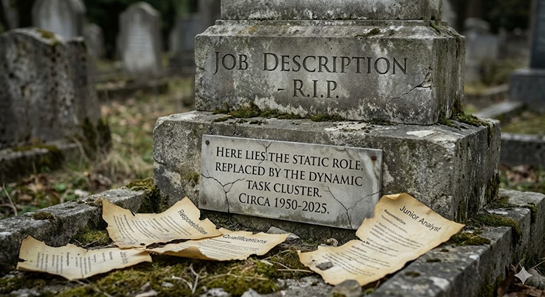
Why "Roles" are Evaporating into "Task Clusters"
For decades, the Job Description (JD) was the bedrock of organizational structure. It was a static document that defined a professional's identity within a company. It listed fixed responsibilities and required historical experience as a predictor of future success.
Today, deep in the era of Agentic AI - where artificial intelligence doesn't just analyze data but takes autonomous action -the traditional JD has become a liability. It is too rigid for the speed at which technology reshapes workflows.
The most forward-thinking organizations are realizing that hiring for a static "Role" is obsolete. Instead, they are hiring for dynamic "Human Task Clusters."
The Core Argument: The Great Unbundling
To understand why the job description is dying, we must understand what a "job" used to be. Historically, a professional role was a bundle of tasks - some high-value, some low-value administrative work.
You hired a "Marketing Manager" and that bundle included everything from crafting high-level strategy (high value) to scheduling social media posts and formatting reports (low value).
AI has unbundled the job.
In 2026, AI agents handle the repetitive, data-heavy tasks within that bundle with vastly superior speed and accuracy. If 60% of a traditional role can now be executed by software, the "role" itself has fundamentally changed. We are no longer hiring humans to execute the volume of work; we are hiring them to apply judgment to the high-stakes remainder.
Illustrations of the Shift
To see this transition from "Role" to "Task Cluster," we need to look at how specific professions are evolving. The human is no longer defined by the output, but by the strategic intervention they provide around the AI's output.
Illustration 1: The Architect
The shift from drafting to synthesis.
The Old Role: A significant portion of the architect's time was spent drafting blueprints, calculating structural loads, and creating 3D renderings.
The AI Reality: Generative design agents can now produce thousands of viable structural permutations and photorealistic renders based on simple prompts instantly.
The New Human Task Cluster: Client Interpretation & Regulatory Navigation.
- The human's value is no longer in "drawing the building." It is in deeply understanding the client's unspoken needs and navigating complex municipal zoning laws—areas where AI lacks nuance and accountability. The human synthesizes the AI's options into a solution that is both functional and human-centric.
Illustration 2: The Financial Analyst
The shift from calculation to context.
The Old Role: Spending hours in spreadsheets cleaning data, running models, and identifying historical trends for a quarterly report.
The AI Reality: AI agents ingest real-time market data, clean it autonomously, and flag anomalies or emerging trends milliseconds after they appear.
The New Human Task Cluster: Risk Intuition & Narrative Strategy.
- The AI identifies what happened. The human is needed to determine why it matters. The human task cluster involves deciding if a data anomaly is a technical glitch or a genuine market threat and then crafting the narrative that explains that risk to company leadership.
The New Framework: Hiring for the "Gap"
If we accept that the static role is gone, how do we hire? We stop looking for titles and start looking for the capabilities that fill the gaps AI cannot yet address.
This requires moving from a Job Description to a Skill Graph approach - viewing employees as a collection of adaptable capabilities rather than fixed functionaries.
The Old Metric (Fixed Role) - Requirement: 5+ years of coding experience
The New Metric (Human Task Cluster) - Cluster: System Architecture & AI Orchestration
The Strategic Logic - AI writes the syntax faster than any human. The human value is in designing the complex system the AI operates within.
The Bottom Line for Leaders
The future of work isn't about humans doing less; it's about humans doing different.
When writing a requisition for talent in 2026, do not ask what the person will do all day. Ask where the AI fails in your current process. The answer to that question is your new human task cluster. It usually involves high-stakes judgment, complex emotional intelligence, or navigating novel situations where historical data - the fuel of AI - does not exist.
Stop hiring for the title. Start hiring for the critical human intervention.
TABLE OF CONTENTS
Smarter Hiring Starts Here
Get all four pillars working for you. Automate the busywork, elevate your hires.